
Join Low Voltage Nation — Find project opportunities and showcase your company to thousands of industry professionals
Cologix reports two Johnstown buildings under construction. Owner specifications and Ohio EPA records identify the scale, five co-permittees and prospective low-voltage work. Artwork is conceptual.
Cologix says construction is underway on the first two buildings at its Johnstown, Ohio, campus, with completion targets at the end of 2027 and early 2028. For low-voltage contractors, the useful detail is in the combination of current facility specifications and public permit records: fiber entrances, meet-me rooms and security systems are advertised, and five construction companies appear in the stormwater co-permittee list.
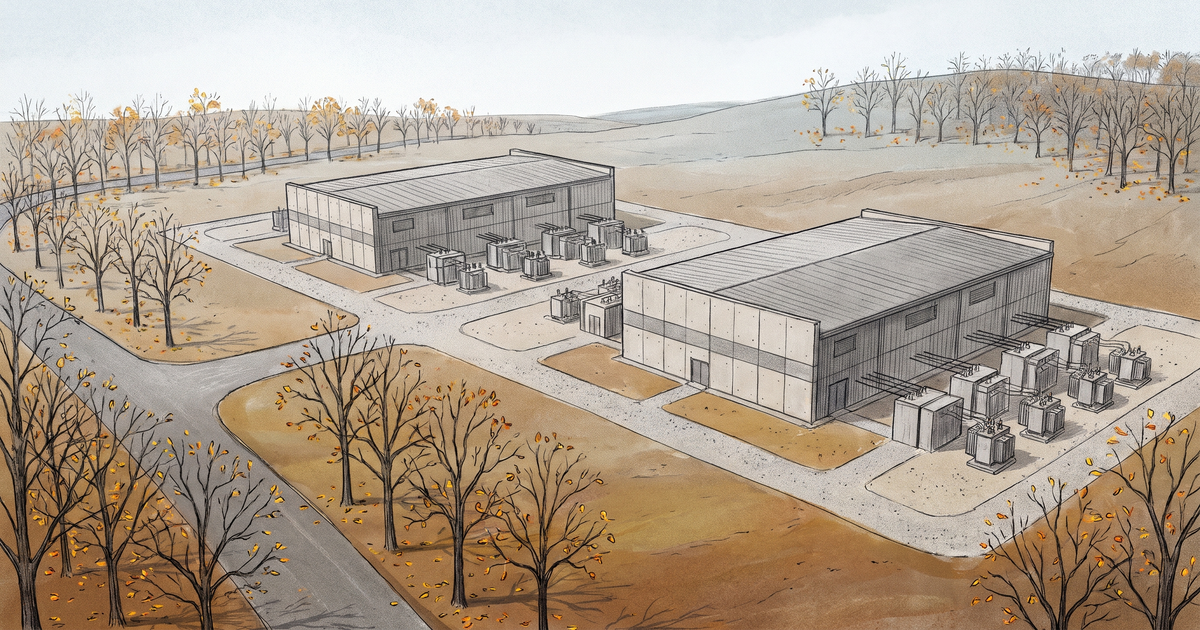
This report connects those sources to practical trade questions. The owner supplies the construction update; Ohio EPA supplies the permit associations. Executed trade contracts, open bid packages, tenant commitments and utility energization remain unverified. The featured image is an AI-generated concept illustration.
Two buildings, with distinct design specifications
The November 13 Cologix update describes the initial construction sequence and forecasts 70–80 direct jobs for the first facilities. Its two completion windows are targets. The announcement does not explicitly attach each window to a building number, so a contractor should obtain a building-specific schedule before planning mobilization.
Cologix lists both facilities on Duncan Plains Road in Johnstown. Its COL7 specification page advertises 245,000 square feet of data-center space and 50 MW of site capacity. The COL8 page advertises 25,000 square feet, additional configurable shell space and 21 MW of site capacity. The shell area is unquantified.
| Facility | Advertised design | Address |
|---|---|---|
| COL7 | 245,000 SF; two stories; 50 MW site capacity | 12017 Duncan Plains Road |
| COL8 | 25,000 SF plus shell; one story; 21 MW site capacity | 11719 Duncan Plains Road |
| Initial construction | Two buildings; owner targets late 2027 and early 2028 | Johnstown, OH 43031 |
These figures describe marketed facility designs. The reviewed sources do not establish critical IT load or energized capacity. COL8’s listed area also needs its shell qualifier whenever it is compared with COL7. Estimating pathways, cameras or cable quantities from square footage and megawatts alone would skip the actual design, tenant requirements and package boundaries.
Ohio EPA names five construction participants
The Ohio EPA construction stormwater list, page 408, identifies “Cologix 7&8” under permit 4GC10864*AG. It lists an October 7, 2025 issue date and 154.47 acres of land disturbance on Duncan Plains Road. That acreage describes the permit’s disturbance area; the record does not establish a surveyed ownership boundary or building floor area.
The corresponding co-permittee list, page 74, connects five firms to that same permit. This is a useful government-record link between named construction participants and the campus. The listing does not document their executed contracts, commercial hierarchy or individual work packages.
| Organization | Verified relationship | Record date |
|---|---|---|
| Cologix | Owner/operator; permit applicant | October 7, 2025 |
| Turner Construction | Stormwater co-permittee | December 30, 2025 |
| Freeland Contracting | Stormwater co-permittee | April 30, 2026 |
| Lithko Contracting | Stormwater co-permittee | June 12, 2026 |
| TWC Concrete | Stormwater co-permittee | May 5, 2026 |
| Precision Engineering & Contracting | Stormwater co-permittee | January 20, 2026 |
The dates are the issue dates in the permit listings. They should not be used as award dates or crew mobilization dates. Turner’s presence is a reason to investigate its project role; this evidence alone does not confirm a general-contractor award. The same discipline applies to Freeland, Lithko, TWC and Precision. Corporate service descriptions can help identify a possible conversation, but the project-specific scope still needs confirmation.
The stormwater record also addresses one approval category. A full construction diligence review would separately examine building permits, utility work, applicable air approvals and inspections. This report does not claim that all approvals are complete.
Power commitments need a precise reading
Cologix’s November update describes approximately $568 million in contracted power-related costs, including collateral, minimum payment obligations and other payments. The owner presents that commitment as part of its approach to protecting existing utility customers. The amount is not a verified construction budget, cash expenditure or financing close. This review did not independently establish the ratepayer outcome or utility delivery milestones.
For a trade contractor, the practical issue is when permanent power, equipment startup and integrated testing become available. Ask which schedule milestone governs the package: building enclosure, utility service, temporary power, equipment acceptance or tenant handover. A campus investment headline does not answer those sequencing questions, and it provides no reliable basis for calculating a low-voltage contract value.
The owner also describes recirculating cooling and dry coolers. Those statements do not establish zero water consumption. Controls teams should work from issued equipment schedules, interface requirements and an approved commissioning sequence. The current marketing pages are useful for identifying design themes, while detailed points lists and responsibilities remain to be obtained.
Where the low-voltage work could sit
Both facility pages advertise diverse fiber connectivity, two meet-me rooms, three minimum points of entry and connections into the Columbus ecosystem. They also identify CCTV and biometric access control. These are concrete owner-described design features. No reviewed source names the low-voltage installer or establishes an open solicitation for those systems.
| Work area | Evidence or analysis | Question to resolve |
|---|---|---|
| Fiber and outside plant | Owner lists diverse entrances and meet-me rooms | Who owns routes, splicing and acceptance? |
| Structured cabling | Prospective pathway and rack coordination | What is base building versus tenant scope? |
| CCTV and access control | Owner lists cameras and biometric access | Who integrates doors, video and monitoring? |
| Fire alarm interfaces | Prospective life-safety coordination | Which approved interfaces and tests apply? |
| BMS and networking | Prospective power/cooling monitoring | Who owns points, protocols and IT/OT handoff? |
| Commissioning | Prospective testing and turnover work | Who witnesses tests and accepts records? |
The table separates advertised features from LVN’s trade analysis. Cabling, fire alarm interfaces, controls and commissioning are investigation areas, with quantities, system architecture and buying responsibility still open. There is no source-backed low-voltage estimate, awarded integrator or bid deadline in the reviewed material.
Fiber teams can begin with a responsibility matrix covering the carrier boundary, campus duct bank, building entrance and meet-me room. Route diversity needs physical confirmation: two cables can share a common trench, crossing or entrance constraint. Ask for drawings that show separation, spare conduit, vault ownership and the test boundary. Establish who supplies splice records, loss results and final route documentation before proposing a handover format.
Inside the building, pathway coordination should address access for installation and later maintenance. Rack layouts, overhead services and equipment clearances can change as tenant requirements mature. A useful qualification discussion asks who releases coordinated drawings and who authorizes deviations. It also establishes the labeling convention and turnover requirements early, so installed work and final documentation remain consistent.
Testing deserves its own scope discussion. The contract should identify required measurements, instrument settings, file formats, acceptance limits and the party reviewing the results. A successful continuity check alone may not satisfy the buyer’s acceptance plan. Agreeing on a sample deliverable before production testing can expose gaps while they are inexpensive to correct. These are general quality practices; the project’s specified methods have not been reviewed.
Security work requires an equally clear division of responsibility. The existence of a camera or biometric-access specification leaves substantial integration questions: door hardware, access permissions, alarm routing, video retention, network services and witnessing of acceptance tests. An integrator should confirm the approved design and interface owner before committing to a system configuration or procurement schedule.
Jobs, trades and preparation
The 70–80 direct-job figure is the owner’s forecast for the initial facilities. It is not a current vacancy count or an estimate of the construction workforce. The update mentions contractor and service-provider opportunities without providing a verified trade hiring breakdown. No specific opening, hiring date, pay rate or required certification was confirmed for this report.
Useful preparation follows the work interfaces. Fiber technicians can strengthen inspection, cleaning, splicing, testing and recordkeeping. Cabling crews need pathway discipline, labeling and grounding/bonding coordination. Security technicians benefit from commissioning practice across doors, cameras and network interfaces. Controls teams need clear alarm ownership, point naming and documented functional checks. These are general capabilities to discuss with a prospective employer or buyer.
The Fiber Optic Association workforce resources offer a starting point for fiber training. OSHA Outreach Training provides general construction-safety education. Neither link establishes a Johnstown hiring requirement. Confirm employer-specific training, lift authorization, site access, supervision and other onboarding requirements directly with the responsible contractor.
Companies preparing a qualification package can assemble relevant completed-project experience, test-equipment capability, sample turnover documentation and available supervision. Insurance, bonding, staffing and safety requirements should come from the actual procurement process. The goal is to make a capability discussion concrete while avoiding a speculative quotation based on incomplete design information.
What contractors should verify next
The next useful evidence is a building-specific construction schedule, a documented procurement contact and the issued scope for the relevant trade. Those details would connect the visible construction milestone to a decision a contractor can act on. A qualified inquiry can reference the owner update and permit association, then ask who manages the package and whether qualification is currently open.
Further milestones to watch include utility service timing, enclosure progress, design release, equipment delivery and commissioning plans. Each affects the sequencing of low-voltage work. Tenant fit-out may have a different buyer and schedule from the base building; that split needs confirmation before treating the campus as one procurement opportunity.
Keep the two buildings distinct in those conversations. A release of work in one facility does not establish the same design maturity, access conditions or turnover date in the other. Ask whether shared campus infrastructure must be completed before either package can be accepted, and whether temporary arrangements create additional testing or remobilization. Written answers are more useful for estimating than a broad campus completion target.
Follow the project through LVN Signal and explore the LVN data-center map. The current evidence supports an active Johnstown construction project, two advertised facility designs and five named stormwater co-permittees. Use those facts to focus the next conversation on scope ownership, schedule and acceptance requirements.
Join 35,000+ Low Voltage Pros
Get weekly permit updates, tool deals, job opportunities, and industry news. No spam, unsubscribe anytime.