
Join Low Voltage Nation — Find project opportunities and showcase your company to thousands of industry professionals
Cochise’s proposed AI campus has conditional power letters and explicit fiber, access-control and detection plans. Review the filing and contractor gaps.
Tombstone Resources L.L.C. has submitted a proposal for a large AI and supercomputing campus near Cochise, Arizona, with enough detail to identify meaningful fiber, security, fire-detection and controls interfaces. The project remains in public review. Its roughly 6,000-megawatt full-build electrical-demand estimate is an applicant forecast; available IT capacity and a guaranteed energization date have not been established.
The useful contractor story is in the underlying documents. The application describes multiple fiber routes, underground campus cabling, restricted building access and detailed detection concepts. It also includes utility letters that spell out the studies, infrastructure and agreements still needed. Together, those records show where technical work could develop and which decisions must come first.
A large proposal enters county review
Cochise County’s current project page identifies application SU26-22, also called the 191 Data Center and BESS proposal. The county received the filing on October 30 and issued a public notice on November 2. Its status remains pending review. The county explicitly attributes the design and operating estimates to the applicant and has not endorsed them.
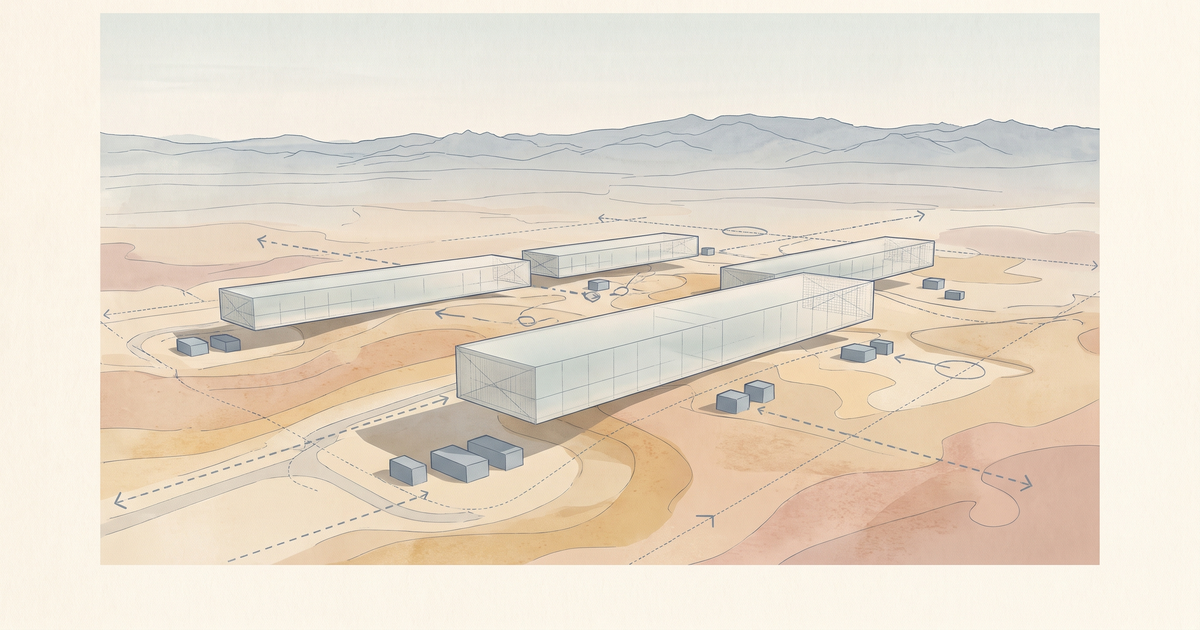
The 54-page application places approximately 747 acres east of U.S. Highway 191, adjoining Arizona Electric Power Cooperative’s Apache Generating Station lands. Tombstone describes purchase arrangements involving AEPCO and Southline Transmission LLC. Those statements establish proposed acquisition arrangements; a completed land closing has not been verified.
| Item | Filed proposal | Qualification |
|---|---|---|
| Location | Cochise, Arizona; about 747 acres | Land closing unverified |
| Buildings | Up to nine; four phases | Conceptual development plan |
| Floor area | About 4.4 million square feet | About 493,000 per building |
| Electrical demand | 1,500 MW initially; 6,000 MW total | Applicant load estimates |
| Battery storage | 24 GWh proposed | Energy-storage measure |
| County status | SU26-22 pending review | Construction authorization unverified |
The application describes five computing buildings on the AEPCO property and four on the Southline property. Each would have associated electrical, cooling and battery infrastructure. Tombstone proposes high-performance computing for AI training and inference, primarily for itself and affiliates. No named tenant, general contractor, architect, engineer or specialty installation award has been verified in the reviewed materials.
Read the power figures by what they measure
The supplemental form identifies approximately 1,500 MW for Phase 1 and 6,000 MW at full build as estimated peak electrical demand. Neither figure establishes critical IT load, commissioned equipment or electricity already available at the site. That distinction matters when comparing this proposal with campuses reporting delivered IT capacity or signed utility allocations.
The proposed 24 GWh battery installation measures stored energy. Separately, the application describes about 10 MW of gas-fired standby generation per computing building for critical services, implying roughly 90 MW across nine buildings. The filing assigns the primary supply role to the grid. Storage and standby figures therefore need separate labels in any project presentation or bid discussion.
The concept drawings introduce another unresolved detail. Sheets on pages 22–23 carry 3,500 MW and 2,800 MW labels, based on 700 MW per building. Their combined 6,300 MW differs from the approximately 6,000 MW narrative. These are preliminary drawings; the discrepancy requires clarification before anyone relies on building-level electrical quantities.
The utility letters define the remaining dependencies
SSVEC’s October 28 letter describes willingness to provide retail service subject to engineering and supply studies, acceptable agreements, interconnection requirements and regulatory approvals. It reports April 2027 as the applicant’s initial-service target. The amount of load available then, and subsequent increases, remain conditional.
AEPCO’s October 29 letter says preliminary transmission studies indicate Phase 1 can be served with identified network upgrades. Additional system-impact, facilities, generation and other studies are underway. AEPCO also describes work to acquire the required generation and transmission resources. The letter does not establish completed procurement or a guaranteed delivery schedule.
The cooperatives describe a proposed three-party energy-services agreement requiring Arizona Corporation Commission review. The SSVEC project information site likewise states that no agreement has been finalized. Its description of member protections and potential benefits remains dependent on negotiated terms and approval.
Tombstone’s application also estimates $3.6 billion in grid upgrades. That is an applicant infrastructure estimate; campus capital expenditure, financing commitments and awarded construction value remain unknown. Contractors evaluating the opportunity should look for an executed service agreement, defined infrastructure responsibilities and a documented phase-specific service schedule.
Who is named, and what their roles establish
| Organization | Documented role | Current limit |
|---|---|---|
| Tombstone Resources L.L.C. | Applicant and proposed operator | Acquisition and financing unverified |
| SSVEC | Prospective retail electricity provider | Conditional service letter |
| AEPCO | Landowner; prospective power provider | Studies and agreements outstanding |
| Southline Transmission LLC | Named landowner and proposed seller | Campus construction award unknown |
| GC and specialty contractors | No verified award identified | Procurement route unknown |
The application supplies the project roles; company websites corroborate organizational identity. Southline’s name in the land description should not be read as a campus EPC or transmission-construction award. Likewise, a product label on a concept sheet does not establish an equipment purchase. Buyers, package boundaries and selected vendors will need project-specific confirmation.
Low-voltage scope is visible in the filing
The clearest telecommunications description appears on application page 50. Tombstone proposes diverse fiber routes along Highway 191 and transmission corridors, service from multiple carriers, and applicant-owned underground fiber within the campus. Carrier identities, signed service commitments, route drawings and an installation contractor remain undisclosed.
The operations narrative adds controlled gates and badge-restricted access. It describes voice-and-strobe alarms, ceiling and underfloor detection, aspirating smoke detection and coordination with suppression systems. Cooling, battery equipment and electrical operations also create monitoring and controls interfaces. These are proposed design elements with substantial engineering and permitting work still ahead.
| Interface | Source-backed plan | Contractor preparation |
|---|---|---|
| Fiber and outside plant | Diverse routes; underground campus fiber | Route, entrance and testing coordination |
| Structured cabling | Applicant names low-voltage technicians | Pathways, labeling and turnover |
| Access control | Controlled gates; badge restrictions | Door and gate interface review |
| Fire detection | Spot and aspirating detection concepts | Approved sequence and acceptance review |
| Controls and networking | Cooling and battery monitoring | Integration and responsibility boundaries |
For an integrator, the immediate value is understanding interfaces. Proposed route diversity raises questions about shared crossings, entrances and failure points. Access control requires coordination with gates, doors and emergency access. Detection and controls need agreed responsibility for alarms, shutdowns, supervision and final testing. These are practical estimating questions, not evidence of released bid packages.
The filing also leaves details that deserve resolution. Its dry-cooling narrative includes residual wording about weather-sensitive spray, while other sections describe a base design without evaporative spray. Generic battery-protection language differs from the detailed narrative’s description of no fixed container suppression. Final coordinated engineering should settle those differences before installers price equipment or acceptance work.
Workforce forecasts and useful preparation
Tombstone forecasts approximately 5,500 workers at peak construction and about 250 operating personnel when the first buildings open, rising to roughly 1,000 at full build. The operating estimates include on-site security, maintenance and other contractors. These figures describe anticipated staffing, with no verified current campus vacancies.
The applicant’s citizen-review letter explicitly identifies fiber and low-voltage cabling technicians among anticipated construction trades. It also names electricians, fire-protection installers, mechanical technicians and construction-management roles. Expected operating categories include controls, networking, fiber and facilities personnel. That makes the workforce relevance more concrete than a generic jobs headline.
For technicians, useful preparation includes fiber inspection and cleaning, documented testing, cable identification, pathway coordination, access-control commissioning and clear turnover records. The Fiber Optic Association’s workforce resources and BICSI education resources provide general training references. No specific certification has been verified as a Cochise hiring requirement.
Contractors can prepare a concise capability statement showing relevant work, crew availability, testing equipment and documentation examples. Before allocating labor, confirm the contracting entity, issued scope, site-access requirements and commercial terms. A utility’s general contact page or an applicant’s community-review contact should not be assumed to function as a recruiting or tender portal.
The next decisions that would make the opportunity clearer
The current county calendar schedules an applicant community meeting for November 4 at 6 p.m. Arizona time and a Planning and Zoning hearing for December 9 at 4 p.m. Arizona time. Both remain scheduled events at this report’s November 4 morning cutoff. Older materials with an unset hearing date have been superseded by the county calendar.
Construction targets also vary by document. The later application narrative estimates one to two years per overlapping phase from vertical construction to occupancy. An earlier applicant letter describes one year for the first phase; the utility FAQ discusses a spring 2027 start and a potentially shorter first-stage interval. Those descriptions have different scopes and do not establish a single dependable completion date.
The most useful next evidence will be the county’s disposition, completed utility studies, final service terms, permit drawings and named contracting parties. Those documents would help separate a broad development ambition from work that can be estimated and scheduled. A land-use decision would still leave applicable construction and outside-agency authorizations to resolve.
Use the county location map when reviewing the proposed site. The public project locator uses a clearly qualified postal-area fallback for 85606; it does not identify a surveyed campus point, entrance or meeting address. Follow the project through LVN Signal and the AI data-center map for source-linked construction context as the public record develops.
Join 35,000+ Low Voltage Pros
Get weekly permit updates, tool deals, job opportunities, and industry news. No spam, unsubscribe anytime.