
Join Low Voltage Nation — Find project opportunities and showcase your company to thousands of industry professionals
Circe's West Texas AI campus has a 1.1 GW target, Cummins power path, regional location, and early LV watch items.
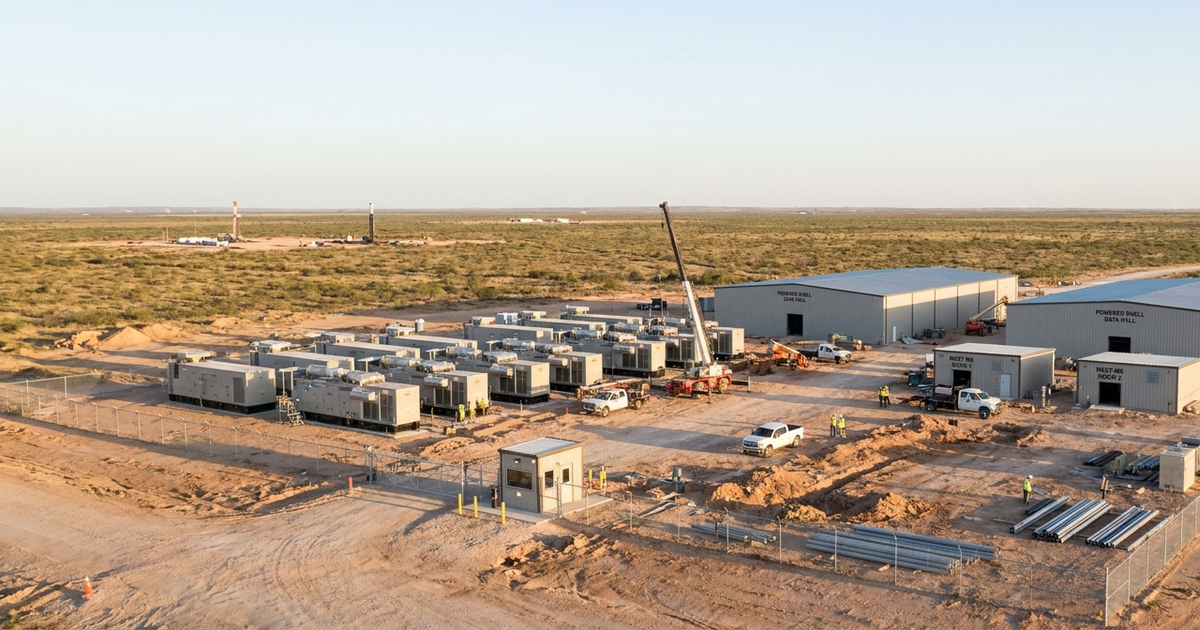
Circe Energy's West Texas AI Infrastructure Campus is a different kind of data-center construction signal. It is not showing up first as a clean municipal building-permit package with a street address, a named general contractor, and a visible trade list. It is showing up as a power-led AI and high-performance computing campus. The source-backed facts point to a regional Permian Basin platform, behind-the-meter natural-gas generation, modular HPC-ready powered shells, fiber connectivity along the I-20 corridor, and a 2026 through 2030 buildout path.
The anchor source is Circe's own HPC/AI data centers page. Circe says its flagship Permian campus is now building, launching with 50 MW in 2026, reaching 150 MW in 2027, and scaling to 1.1 GW by 2030. The page describes behind-the-meter natural gas power, 10 MW and 24 MW modular deployment blocks, liquid-cooling-ready densities from 70 to 132 kW per rack, dual meet-me rooms, diverse carriers, BMS/SCADA, physical security, and I-20 fiber corridor connectivity. Those details are directly relevant to low-voltage contractors because they describe the systems that have to be designed, installed, tested, documented, monitored, and commissioned around the power and compute platform.
The paired power-equipment signal comes from Circe's June 16, 2026 announcement distributed by PR Newswire. Circe says it ordered about 2 GW of Cummins natural-gas generation capacity for delivery from 2026 through 2030. The release frames the flagship site as a 1,950-acre Permian Basin development platform for gigawatt-scale AI and HPC infrastructure. That 2 GW number should be handled carefully. It is ordered generation capacity for the West Texas campus and future North American deployments, not a confirmed building-level IT critical-load number for one data-center shell.
| Project Fact | Source-Backed Detail | LVN Read |
|---|---|---|
| Location | West Texas / Permian Basin; county and street address not disclosed in reviewed sources. | Map as regional fallback until permits or local records reveal a precise site. |
| Campus scale | Circe lists 50 MW in 2026, 150 MW in 2027, and 1.1 GW by 2030. | Large enough to justify early OSP, fiber, security, controls, and commissioning tracking. |
| Generation order | Circe says about 2 GW of Cummins generation capacity was ordered for 2026-2030 delivery. | Power equipment capacity, not confirmed IT load or low-voltage contract value. |
| Site platform | PR Newswire release describes a 1,950-acre Permian Basin development platform. | Expect phased site, power, carrier, controls, security, and data-hall buildout signals. |
| Construction status | Circe says the West Texas HPC campus is now building. | Track public records for the county/address and named project delivery partners. |
Cummins is the named vendor that makes this project more than a generic future-campus claim. The Cummins release says the company will supply HSK78 and QSK60 high-horsepower natural gas generator sets for Circe's Texas HPC data-center microgrid, with deliveries scheduled from 2026 through 2030. Because the main Cummins page returned local security verification during screenshot capture, the live evidence packet also uses the accessible Cummins investor-relations release. The important contractor distinction is that Cummins is source-backed as generator and technical-validation support. Cummins is not named in reviewed sources as EPC, general contractor, electrical contractor, controls contractor, or low-voltage contractor.
Trade coverage supports the same read. Data Center Dynamics summarizes the 2 GW natural-gas generation order, the 1,950-acre Permian Basin site, 2026-2030 delivery timing, and 1.1 GW 2030 scale target. Baxtel repeats the Permian Basin location, the 150 MW 2027 launch expectation, and the behind-the-meter generation model. Local Midland Reporter-Telegram coverage adds regional market confirmation, although the local screenshot was not used because a subscription modal obscured the page in headless capture.
For LVN, the project is publishable because the owner and vendor trail is strong, but the contractor stance needs to stay conservative. Reviewed sources do not identify a county, street address, air-permit record, water record, interconnection filing, economic-development agreement, engineer of record, EPC, general contractor, electrical contractor, low-voltage contractor, fiber or OSP contractor, security integrator, fire alarm contractor, BAS/BMS contractor, DAS provider, grounding contractor, or commissioning firm. The practical value today is not a named package award. It is a live, source-backed watch signal around a power-led AI campus that will need low-voltage coordination as the site becomes more public.
| Entity | Source-Backed Role | Evidence |
|---|---|---|
| Circe Energy LLC | Developer / owner-operator context for the West Texas HPC campus. | Circe project page and company site. |
| Cummins Inc. | Natural-gas generator supplier and technical-validation support. | Cummins release and investor-relations mirror. |
| Cummins Power Systems | Power-generation equipment platform for microgrid support. | Cummins generator announcement. |
| PR Newswire | Distribution source for Circe's 2 GW generation announcement. | Circe / PR Newswire release. |
| Data Center Dynamics | Secondary data-center market coverage. | DCD Circe West Texas article. |
| Baxtel | Secondary data-center market profile. | Baxtel Circe 2 GW coverage. |
The low-voltage angle starts with the design promises on Circe's own page. Dual meet-me rooms and diverse carriers imply outside-plant planning, carrier coordination, entrance facilities, backbone pathways, fiber testing, labeling, documentation, and ongoing carrier turn-up support. Liquid-cooling-ready high-density racks imply stronger coordination between data-hall pathways, power, cooling, controls, leak detection, monitoring, and commissioning teams. BMS/SCADA language points to controls integration and network segmentation around facility systems. Behind-the-meter generation adds OT-network, security, monitoring, grounding, alarm, and commissioning interfaces that may appear before traditional tenant fit-out work.
That does not mean low-voltage firms should pitch as if packages are open tomorrow. The better move is to build a source file, watch for precise location records, and map the public trail as it appears. If a TCEQ air permit, county incentive agreement, utility filing, construction permit, water record, or local road/site-plan package appears, it can turn a regional story into a specific addressable project. Until then, outreach should be careful: reference the public Circe and Cummins facts, acknowledge the unknowns, and avoid pretending to know the delivery team.
| LV System | Why It Matters | Public Signal To Watch |
|---|---|---|
| Fiber / OSP | Circe references I-20 fiber corridor connectivity, diverse carriers, and dual MMRs. | Carrier, conduit, easement, meet-me room, vault, and fiber-contractor records. |
| Structured cabling | Modular HPC shells and high-density racks still need pathways, labels, tests, and turnover files. | Tenant fit-out, rack/row, tray, pathway, and data-hall cabling packages. |
| Access control / CCTV | Large remote campuses need perimeter, building, equipment, loading, and operations coverage. | Security integrator awards, device schedules, fence/gate work, and commissioning jobs. |
| Fire alarm | Life-safety systems must coordinate with suppression, generator areas, cooling, and AHJ inspections. | Fire alarm permits, suppression interfaces, inspection movement, and specialty names. |
| BMS/BAS / SCADA | Circe explicitly references BMS/SCADA for the campus design. | Controls integrator, point lists, OT network boundaries, trend logs, and turnover records. |
| DAS / networking | Remote, large-format buildings often need wireless coverage and resilient facility networks. | DAS design, public-safety coverage, carrier coordination, and IT/OT integration roles. |
| Grounding / commissioning | Power-led campuses need clean bonding, test evidence, alarm validation, and operational turnover. | Electrical coordination, QA checklists, commissioning agent, and punch-list records. |
Technicians should read this as an early skills signal. Fiber cleaning and testing, OSP documentation, copper certification, cable tray and pathway coordination, access-control commissioning, camera aiming and validation, fire alarm interface coordination, BAS/BMS point awareness, SCADA-adjacent networking discipline, grounding and bonding, lift and site-safety readiness, redlines, labels, photos, and closeout documentation all matter on data-center work. The campus may also reward crews that understand power-generation sites, fuel/generator safety boundaries, controls networks, and how low-voltage systems behave around utility-scale electrical infrastructure.
For owners of small low-voltage firms, the near-term action is preparation, not a blind bid chase. Build a one-page capability sheet around data-center safety, fiber test gear, labeling discipline, secure-site experience, commissioning documentation, and crew availability in West Texas. Then wait for a public delivery-team signal that identifies who is buying labor. That is a stronger position than sending generic outreach to Circe before the county, permit path, and prime contractors are visible.
The most important open item is location precision. The current Signal row is intentionally geocoded as a regional Permian Basin fallback because no reviewed primary source identifies a county, road, parcel, or municipal jurisdiction. That is acceptable for an intelligence post only if the caveat stays visible. Do not infer Midland, Odessa, Pecos, Reeves County, Ector County, or any other specific jurisdiction from regional language. The next higher-confidence update would be a public record that ties Circe, an affiliate, Cummins equipment, gas generation, or HPC/data-center construction to a parcel, county, or permit number.
Contractors should monitor Circe, Cummins, Texas Commission on Environmental Quality records, ERCOT and utility-region filings, county agendas, tax-abatement records, air and water permits, local job postings, plan-room references, and supplier announcements. Also track aliases: Circe Energy West Texas AI Infrastructure Campus, Circe West Texas HPC Campus, West Texas AI campus, Permian Basin AI data center, Cummins Circe 2 GW, and Circe behind-the-meter AI campus. Keep it distinct from Chevron / Microsoft Project Kilby, Google / Intersect Meitner, Pacifico GW Ranch, and other Permian or West Texas power-adjacent AI projects.
The bottom line: Circe's West Texas campus is now source-backed enough for LVN Signal, but not mature enough to name specialty contractors. Circe is the developer/operator context. Cummins is the power-generation vendor. The 1.1 GW figure is Circe's West Texas campus scale target by 2030. The 2 GW figure is ordered generation capacity for this campus and future deployments. County, address, EPC, GC, electrical, fiber, security, fire alarm, BAS/BMS, DAS, networking, grounding, and commissioning package names remain unknown until public evidence names them.
Join 35,000+ Low Voltage Pros
Get weekly permit updates, tool deals, job opportunities, and industry news. No spam, unsubscribe anytime.