
Join Low Voltage Nation — Find project opportunities and showcase your company to thousands of industry professionals
DOE selected Brookfield for a reported 1.8GW Paducah AI campus, with NextEra tied to 2GW of generation, 2.6GW of storage, and transmission upgrades.
The U.S. Department of Energy has selected Brookfield to develop and operate a major AI data-center campus at the former Paducah Gaseous Diffusion Plant in Kentucky. Associated Press reporting identifies NextEra Energy as the company expected to build and own the supporting power infrastructure, putting a named developer and energy partner behind one of the largest federal-land AI infrastructure proposals in the country.
The current framework is enormous: roughly $100 billion, a reported 1.8-gigawatt data-center campus, 2 gigawatts of natural-gas generation, 2.6 gigawatts of battery storage, transmission upgrades, thousands of jobs, and a 2031 target. Every one of those figures needs to be read as a planned program subject to definitive agreements, interconnection work, permits, financing, environmental review, and construction execution.
The capacity labels also matter. The 1.8 GW figure refers to reported campus capacity. The 2 GW gas-generation fleet and 2.6 GW battery system are supporting energy assets, not additional data-center IT load. Public sources reviewed for this report do not disclose building-level critical IT load, data-hall count, total data-center square footage, or a committed AI tenant.
| Project fact | Source-backed detail | LVN read |
|---|---|---|
| Site | Former Paducah Gaseous Diffusion Plant | Federal industrial land in McCracken County. |
| Developer | Brookfield selected | Expected to develop and operate the campus. |
| Power partner | NextEra Energy | Reported builder and owner of energy infrastructure. |
| Campus capacity | Reported 1.8 GW | Building-level IT load remains undisclosed. |
| Energy assets | 2 GW gas; 2.6 GW battery | Supporting generation and storage. |
| Target | 2031 | Subject to approvals and execution. |
DOE's Paducah request for offers is the primary public record behind the opportunity. It confirms that the federal site was offered for privately funded AI data-center and energy-generation development. The private developer is responsible for construction, operation, eventual decommissioning, utility interconnection, permitting, and regulatory compliance.
That structure is important for contractors. DOE is the federal landowner and selection authority, but it is not acting as the data-center general contractor. Brookfield and its project structure will need to turn the selected concept into phased site plans, power agreements, environmental filings, building designs, trade packages, inspections, energization milestones, and commissioning plans.
DOE's broader federal AI infrastructure site-selection announcement places Paducah among four selected federal sites. The Paducah site profile describes roughly 3,556 acres of former uranium-enrichment property with ongoing cleanup and reindustrialization activity. That legacy creates both opportunity and coordination risk: new work must coexist with federal property controls, environmental obligations, existing contractors, industrial utilities, and site-specific safety requirements.
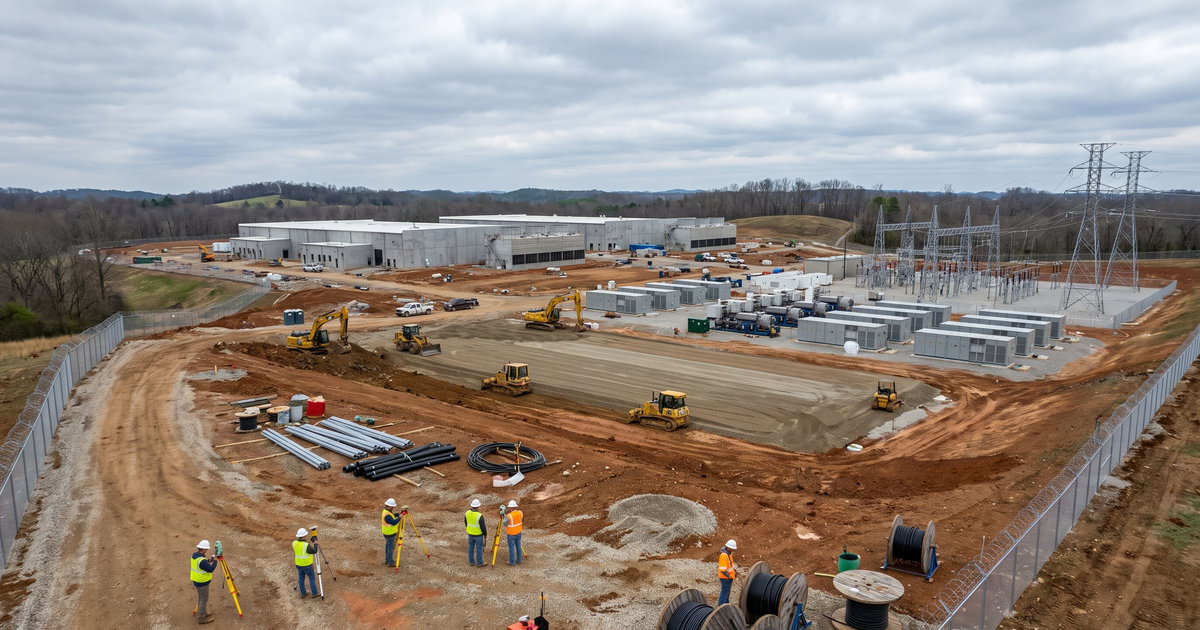
The public record does not yet identify the final data-center parcel boundaries, construction entrance, laydown zones, building count, data-hall configuration, cooling architecture, water strategy, substation locations, transmission route, gas-generation footprint, battery layout, or fiber entrance paths. The current Signal map therefore uses a Paducah city fallback rather than pretending the campus has a precise construction address.
Brookfield's infrastructure platform provides relevant company context. Brookfield describes a global data-center and AI-ready campus portfolio that includes platforms such as Compass and Data4. That demonstrates capability, but it does not prove that any Brookfield portfolio company, contractor, design standard, or existing vendor has been assigned to Paducah.
NextEra Energy separately documents its ability to develop gigawatt-scale data-center energy infrastructure, generation, capacity, and interconnection solutions. For Paducah, AP reports NextEra will build and own the supporting power assets. The final utility participants, power-service structure, transmission owners, interconnection queue references, fuel arrangements, operating permits, and substation responsibilities remain unresolved.
| Company / agency | Source-backed role | Current limit |
|---|---|---|
| Brookfield | Selected campus developer and operator | Selection reporting |
| NextEra Energy | Reported power-infrastructure builder and owner | Selection reporting |
| U.S. DOE | Federal landowner and selection authority | Federal solicitation |
| McCracken County | Local jurisdiction context | DOE site profile |
| Greater Paducah ED | Regional development context | Local updates |
| Data-center GC / design | Not publicly named | Do not infer an award. |
No reviewed source names a data-center general contractor, EPC or EPCM firm, architect, civil engineer, structural engineer, MEP engineer, electrical contractor, low-voltage integrator, fiber or outside-plant contractor, structured-cabling contractor, security integrator, fire alarm contractor, BAS/BMS/EPMS vendor, DAS contractor, grounding contractor, or commissioning authority.
NextEra's power role also should not be stretched into an award for data-center building construction. Its source-backed lane is supporting generation, storage, transmission, and related energy infrastructure. Brookfield is the selected developer/operator. The boundary between those programs and the future building primes will become clearer only through definitive agreements, design filings, permit records, procurement notices, contractor portfolios, and project-specific hiring.
The power package alone can create substantial communications and controls work. Utility fiber, protection-and-control communications, SCADA, metering, station LANs, cybersecurity boundaries, remote alarms, weather monitoring, access control, CCTV, fire detection, grounding, time synchronization, battery management interfaces, and integrated testing can sit across utility, electrical, controls, security, and commissioning scopes.
The battery-storage component adds another controls layer. A multi-gigawatt storage program requires monitoring, energy management, protection interfaces, network segmentation, environmental sensing, fire detection, emergency communications, remote operations, event logging, and coordinated acceptance testing. The final technology, enclosure count, site layout, integrators, and code strategy have not been publicly named.
The gas-generation plan will require its own instrumentation, control, communications, security, life-safety, grounding, and commissioning systems. Those power-plant packages may be procured separately from the data centers, and their timelines may lead the first data-hall construction. Contractors should track package-specific evidence rather than assuming a single campus-wide prime will hold every scope.
| Low-voltage lane | Likely requirement | Watch signal |
|---|---|---|
| Fiber / OSP | Carrier, campus, utility, and generation links | Easements, duct banks, MMRs, splice and test packages. |
| Structured cabling | Operations, support, controls, and data-hall pathways | Standards, labeling, certification, and turnover specs. |
| Security | Federal-site perimeter and critical facilities | Gates, access control, CCTV, SOC, and visitor systems. |
| Fire alarm | Data halls, power, storage, and support spaces | Detection, interfaces, sequence testing, and AHJ review. |
| BMS / EPMS / SCADA | Power, cooling, storage, and remote operations | Point lists, networks, integrations, and trend requirements. |
| Commissioning | Integrated power, controls, security, and life safety | CxA award, test scripts, witness plans, and training. |
Fiber and outside plant should appear early because the campus must connect data centers, energy assets, substations, operations facilities, security posts, and outside carriers across a large industrial site. Watch for diverse carrier entrances, long-haul route announcements, easements, campus duct banks, handholes and maintenance holes, utility communications, meet-me rooms, splice plans, redundant backbones, and optical-loss or OTDR testing requirements.
Structured cabling scope will depend on the tenant and owner architecture. AI systems may arrive as customer-furnished racks and high-speed fabrics, but owner systems still need pathways and connectivity for operations, out-of-band management, wireless, security, fire alarm interfaces, controls, environmental monitoring, offices, warehouses, maintenance spaces, and the networks joining data halls to site infrastructure.
Security will be unusually important on a federal industrial property. The eventual design may need to coordinate DOE property controls with developer and tenant security zones. Practical watch items include vehicle barriers, guard facilities, credentialing, badging, biometric readers, visitor management, access control, video surveillance, analytics, intercom, duress, key management, security operations integration, retention policy, and cybersecurity requirements for physical-security systems.
Fire and life safety will span data halls, electrical rooms, generators, battery systems, fuel systems, cooling equipment, warehouses, offices, and site infrastructure. Detection, releasing interfaces, supervisory points, emergency-power behavior, voice or mass notification, monitoring, cause-and-effect matrices, integrated tests, and authority-having-jurisdiction acceptance will create several coordination boundaries.
BMS, EPMS, SCADA, DCIM, and OT networking will have to divide responsibility cleanly. Power generation and batteries need plant controls; substations need protection and telemetry; data centers need electrical and mechanical visibility; operators need alarm routing, trending, dashboards, failover logic, and historical data. Integration points should be source-backed before any vendor is attached to the record.
DAS, public-safety radio, cellular, Wi-Fi, and private wireless requirements remain unknown. The property scale and mix of heavy industrial, energy, support, and data-center buildings could create coverage challenges. Requirements will depend on jurisdictional radio tests, carrier strategy, tenant standards, site operations, and emergency-response plans.
Grounding and bonding will connect the transmission and substation systems, generation, battery storage, structural steel, lightning protection, switchgear, UPS systems, cable tray, racks, telecom rooms, OSP entrances, controls panels, security devices, and cooling systems. Final ownership of testing, documentation, and corrective work has not been disclosed.
Commissioning is the bridge across all of those systems. A campus of this size will need staged turnover, factory tests, site acceptance, power-quality checks, point-to-point verification, network readiness, alarm testing, cooling sequences, security and fire interfaces, failure-mode tests, integrated systems testing, operator training, and disciplined digital closeout. The commissioning authority and package structure remain open.
Contractors can prepare without pretending a bid is open. Useful readiness includes federal-site and mission-critical safety, insurance and bonding capacity, EMR documentation, lift and site-access credentials, fiber cleaning and inspection, fusion splicing, OTDR and optical-loss testing, copper certification, pathway coordination, grounding and bonding, access-control and VMS commissioning, fire alarm acceptance support, controls point-to-point testing, redlines, labeling, and complete turnover records.
Prequalification materials should show available regional labor, Kentucky and multistate licensing, industrial or data-center references, QA/QC plans, testing equipment, manufacturer certifications, field supervision, schedule controls, commissioning experience, cybersecurity practices for connected systems, and examples of as-builts and digital closeout. Federal-property access and site-specific training may become additional requirements.
The Greater Paducah Economic Development news stream is a useful local monitor, along with DOE notices, McCracken County and Paducah records, Kentucky Public Service Commission filings, environmental permits, federal lease documents, utility proceedings, contractor job postings, plan rooms, engineering portfolios, and supplier announcements.
Alias control will matter. Track Brookfield Paducah AI campus, NextEra Paducah energy campus, DOE Paducah AI data center, PGDP AI campus, Paducah Gaseous Diffusion Plant data center, and McCracken County AI data center. Keep this project distinct from the separate uranium-enrichment initiatives at Paducah and from the SB Energy / SoftBank PORTS campus in Piketon, Ohio.
The business-development angle is real but early. LVN now has a source-backed record for the federal site, selected developer, power partner, reported scale, energy framework, project obligations, and expected trade impact. Brookfield, NextEra, agencies, and future project firms can correct the record, claim profiles, provide verified package or hiring updates, or sponsor continued coverage without LVN claiming that procurement is already open.
Bottom line: Paducah is a high-confidence predevelopment watch with a named developer and energy partner, but most building-level details are still unknown. The next decisive evidence will be definitive agreements, parcel and site plans, interconnection filings, environmental permits, transmission and substation details, data-center building filings, design-team appointments, contractor awards, fiber routes, specialty packages, and a phased commissioning schedule.
Join 35,000+ Low Voltage Pros
Get weekly permit updates, tool deals, job opportunities, and industry news. No spam, unsubscribe anytime.