
Join Low Voltage Nation — Find project opportunities and showcase your company to thousands of industry professionals
Brightview Senior Living is building 170 independent living, assisted living and memory care residences on the Notre Dame of Maryland University campus — the first senior living community to break ground on a college campus in Maryland. Five low voltage systems, an estimated $2.4M-$3.0M, and two occupancy classifications that decide the entire design.
Our first senior living spotlight, and the permit for this one is unusually generous. It tells you the occupancy groups and the construction types, which on this building type is the same thing as telling you the design.
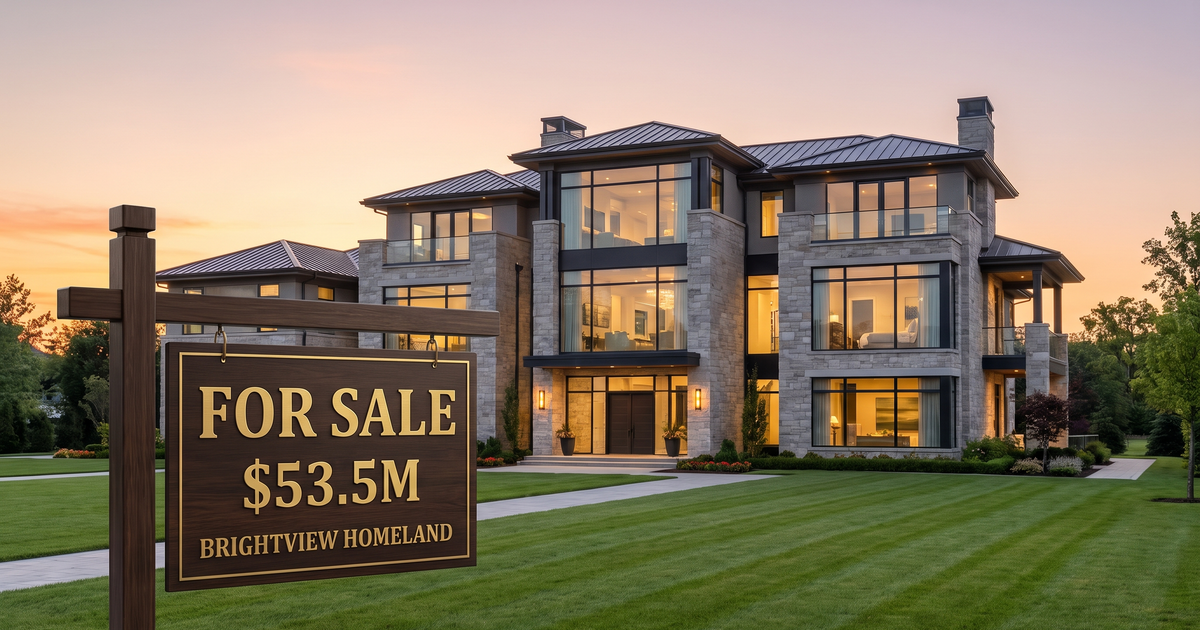
Brightview Senior Living is building a $53,491,053 community at 201 Homeland Avenue in north Baltimore — 170 residences spanning independent living, assisted living, and Brightview's Wellspring Village memory care program, on 3.7 acres of the Notre Dame of Maryland University campus. It broke ground in January 2026, replaces a former Knights of Columbus property, and opens in 2028.
It is also the first senior living community to break ground on a college campus in Maryland. Hold that thought, because it changes the job in ways that are not obvious.
Read The Occupancy Groups. They Are The Brief.
Here is what the permit actually says:
- Independent living — 4 stories plus basement, mixed use, Groups R-2, A, I-1 Condition 2, and S, Construction Type VA
- Assisted living and memory care — 4 stories, mixed use, Groups I-1 Condition 2, R-2, and S, Construction Type IIA
- NFPA 13 standpipe and sprinkler system throughout
Two details in there are worth more than the dollar figure.
First: I-1 Condition 2. Group I-1 covers residential care where occupants receive custodial care. Condition 2 is the classification for occupants who are not capable of self-preservation without physical assistance — as distinct from Condition 1, where residents can respond to an emergency and get out on their own.
That single designation drives the life safety strategy. When residents cannot self-evacuate, the building is not designed to empty out — it is designed to defend in place, moving people horizontally to a protected smoke compartment and holding them there. Which means your fire alarm scope is not a code-minimum device count. It means detection in sleeping units and corridors, smoke compartment boundaries that your cabling has to cross correctly, and a notification and staff-alert design built around the assumption that staff are physically moving residents.
Second: two different construction types in one project. Type VA for independent living, Type IIA for assisted living and memory care. Different fire-resistance ratings, different assemblies, different penetration details.
Practically: one cable schedule and one firestop detail will not cover both buildings. If you price this as a single residential job and carry one set of assumptions across the whole site, you will discover the difference during inspection on the half you got wrong. Split your takeoff the way the permit splits the building.
Memory Care Is A Low Voltage System Most Contractors Have Never Installed
Wellspring Village is memory care, and memory care carries a subsystem that does not exist in any other building type: wander management, sometimes called elopement prevention.
Residents wear a tag. Door controllers sit at every egress point from the secured neighborhood — exterior doors, stair doors, and the elevators. When a tagged resident approaches, the door locks or alarms, and staff are notified.
Three things about it that bite people who have not done it:
- It has to integrate with access control, not compete with it. Staff and visitors move through the same doors that are restricted to residents. That is one opening with two entirely different rulesets.
- It has to release on fire alarm. Controlled egress and delayed egress hardware is code-permitted in I-1 and I-2 occupancies precisely so memory care can be secured, but it must fail safe on alarm and on power loss. Your interface to the fire alarm panel is a life safety circuit, and it will be inspected as one.
- Elevators are egress points too. A resident who can call an elevator can leave the floor. Elevator access control has to be part of the wander design, not an afterthought bolted on during closeout.
Nurse Call Here Is Not Hospital Nurse Call
The system list includes nurse call, and if your reference projects are hospitals, know that you are being asked for something related but different.
Senior living uses resident emergency call: pull cords in bathrooms and bedrooms, wearable pendants, and increasingly wireless infrastructure — with a reporting layer the operator uses for staffing decisions and for regulatory documentation of response times. Different manufacturers, different product families, and different listings than acute care nurse call.
And the coverage expectation is total. In assisted living, every residence gets emergency call. On 170 residences that is a large, repetitive, schedule-driving scope, and it is the piece that determines whether you finish.
Three Care Levels, Three Opposite Philosophies, One Building
This is the part that makes senior living genuinely hard, and it is why our hospitality rule applies here too: price each half separately.
Independent living residents are tenants. They want apartment-grade connectivity, their own service, and they emphatically do not want the building to feel institutional. Visible devices, obvious cameras and clinical hardware in an independent living corridor are a marketing problem for the operator.
Memory care, twenty feet away, needs supervision, containment and documentation.
Same project, opposite design goals, and the transition between them is where the coordination effort concentrates. Ask early which spaces are which, and where the boundary sits.
What The Low Voltage Is Worth
We benchmark this as a hybrid, blending residential and care:
- Independent living prices close to multifamily — call it 3 percent
- Assisted living and memory care carry emergency call in every unit, wander management, and heavier fire alarm density — call it 6.5 percent
- Blended base around 4.5 percent, times a 1.15 system-count multiplier, is about 5.2 percent
On $53,491,053 that is roughly $2.78 million, and we would publish the range as $2.4M to $3.0M.
There is a more useful unit here though. Across 170 residences, that works out to about $16,350 of low voltage per residence. Senior living behaves like hospitality in this respect — the per-key number travels between projects better than a percentage does, because the unit count drives the device count. Call it $12,000 to $20,000 per residence, mid around $16,000, and sanity-check any senior living estimate against it.
The Rest Of The Building Is Not Apartments
Do not let the residence count hide the commercial program. The main entry and basement levels include a full commercial kitchen, dining facilities, multi-purpose and fitness rooms, a commercial laundry, and support offices.
That means hood suppression interfaces to the fire alarm, equipment monitoring, AV in multi-purpose and fitness spaces, and back-of-house infrastructure that has nothing to do with the residential floors above it. There are also four passenger elevators and a freight elevator — recall, firefighter's service, and, as noted, access control integration.
The Campus Is The Wrinkle
Building on 3.7 acres of an operating university campus is a different animal from a greenfield suburban site, and this is the first time Maryland has done it for senior living.
Questions to get answered before you bid, because nobody will volunteer them:
- Where does the service enter, and whose network is it? Does the community stand alone with its own carrier entrance, or does it ride any part of the university's infrastructure? That single answer moves your outside plant scope substantially.
- Does anything integrate with campus security? A senior living community with its own access control sitting inside a university with its own is a policy question that becomes a wiring question.
- What does the academic calendar do to your schedule? Campus logistics, laydown, deliveries and noise windows all bend around a semester.
- What is the intergenerational programming? The partnership is the selling point, and shared or shuttle-connected program space usually implies AV and connectivity nobody put in the base scope.
Who To Call
Brightview Senior Living is the developer and operator. Operators who run a portfolio have technology standards — approved emergency call platforms, access control preferences, network architecture, and handover documentation formats that repeat community to community. Ask for the standard early. Being fluent in a portfolio operator's platform is exactly the kind of qualification that turns one job into a pipeline, the same way brand-standard fluency decides hospitality work.
Notre Dame of Maryland University is the campus partner and landowner side of the deal.
No general contractor, electrical, low voltage, security, fire alarm or emergency call contractor appears in the record we reviewed. Demolition of the former Knights of Columbus building came first with full construction following, and the community opens in 2028 — so the systems buyout is a 2026 and 2027 conversation, happening now.
Track projects like this before the bid drops. LVN Signal monitors permits, bids, and construction news across the country and scores every project for low voltage opportunity. See what is in your market.
Join 35,000+ Low Voltage Pros
Get weekly permit updates, tool deals, job opportunities, and industry news. No spam, unsubscribe anytime.