
Join Low Voltage Nation — Find project opportunities and showcase your company to thousands of industry professionals
Bell AI Fabric Sherwood is a 300 MW Saskatchewan AI data-centre build with Bird Construction named, early works underway, and low-voltage packages still open to track.
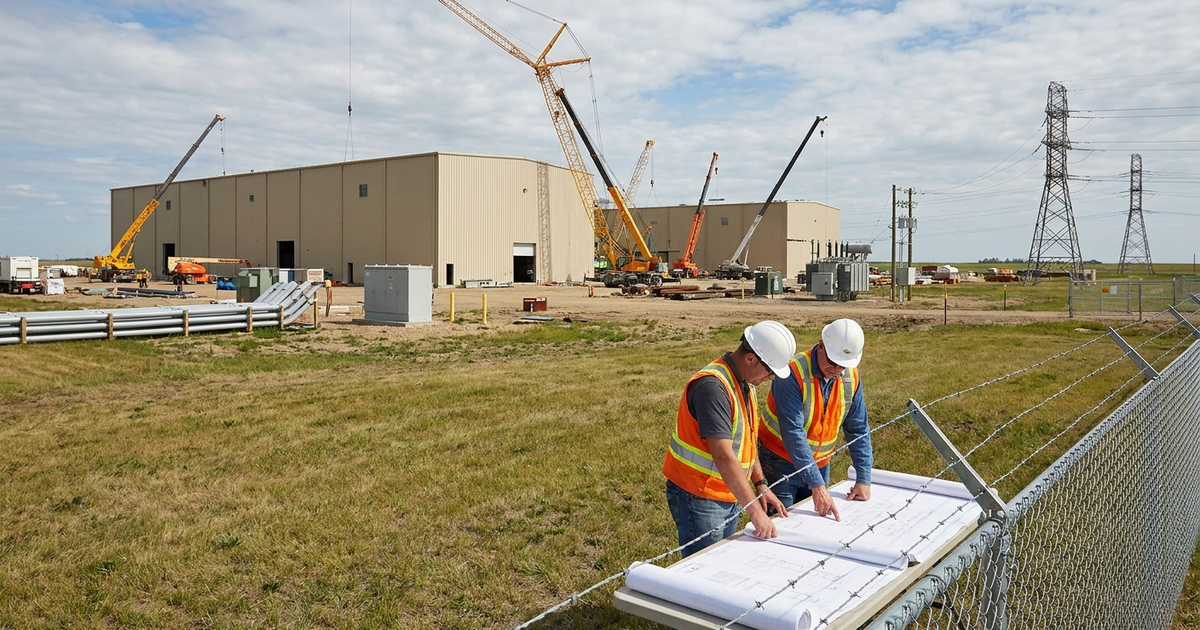
Bell's Sherwood AI Fabric campus has moved into construction delivery
Bell AI Fabric's Saskatchewan build is now a practical construction story, not just an AI infrastructure announcement. Bell's March project backgrounder describes a 300 MW AI data centre in the Rural Municipality of Sherwood, just outside Regina, with approximately C$1.7 billion in Bell capital investment for the physical facility. Bell says the first two data halls are expected to enter service in the first half of 2027, followed by two more halls in the second half of 2027. The tenants named for the compute layer are Cerebras and CoreWeave, while Bell positions the campus as sovereign Canadian AI capacity.
The latest construction signal is the partner map. On May 14, 2026, Bell announced that Bird Construction Inc. had been selected as construction partner for the Sherwood facility, with Alton Tangedal Architect Ltd. as architect of record and George Gordon Developments Ltd. tied to site services and Indigenous workforce participation. Bird also republished the announcement on its own site, giving LVN a contractor-side source for the same role.
Bell had already published the first package layer. Its May 4 update says early site works began on April 21, 2026, after the Rural Municipality of Sherwood approved the development agreement on April 20. That update names Hipperson Construction for early works and building construction management, Maxie's Excavating for earthworks, Behlen Industries for pre-engineered building supply, Soletanche Bachy Canada for piling, Ardel Steel for piling rebar, Amrize for piling concrete, Red Pelican for energy-code compliance, and WaterMark Consulting for well-water monitoring.
Project snapshot
| Item | Public signal |
|---|---|
| Project | Bell AI Fabric Sherwood Saskatchewan AI Data Centre |
| Location | Rural Municipality of Sherwood, Saskatchewan, near Regina |
| Power scale | 300 MW gross demand / AI data centre campus |
| Facility investment | About C$1.7B Bell capex for the physical facility |
| Construction stage | Early works underway after April 2026 local approval |
| Target service | Two halls in H1 2027 and two more in H2 2027 |
| Jobs | At least 800 construction, engineering, and technical jobs, plus up to 80 operations roles |
Why this matters for low-voltage contractors
A 300 MW AI campus is a large electrical and mechanical job first, but low-voltage work shows up everywhere once the shell, power, and site packages turn into data halls. The current public record names Bell, Bird, the architect, the site-services partner, and early civil/building partners. It does not yet name the structured cabling contractor, fiber/OSP contractor, security integrator, fire alarm contractor, BAS/BMS controls integrator, DAS/networking contractor, grounding/bonding specialty team, or commissioning agent.
That gap is the opportunity. LVN should not guess the package awards. The useful move is to watch the top-level account map, the early works sequence, the utility and access-road work, and the hiring or procurement signals that usually precede specialty awards. Bird's announcement also matters because Bell describes the Sherwood facility as the first project in a longer Bell/Bird AI data-centre buildout, which could make Bird a recurring account to understand if future Canadian AI Fabric projects follow the same delivery model.
Bell's community page adds project-design context. The Regina/Sherwood project page says the facility is planned around a sealed closed-loop cooling system paired with air-cooled heat rejection, a dedicated SaskPower industrial feed, low-noise equipment choices, landscaped setbacks, dark-sky-compliant lighting, drainage planning, and project-funded road and access upgrades. Those details matter because low-voltage teams often coordinate around perimeter security, access control, CCTV coverage, telecom entrances, pathways, grounding, labeling, controls, and commissioning documentation in the same areas where civil, power, mechanical, and security packages overlap.
The account sequence also tells vendors where to spend time. Bell owns the facility strategy and public community narrative. Bird is the construction partner and now has a strategic relationship with Bell that can extend beyond Sherwood. ATAL and GGDL are local/regional partners attached to design, site services, and workforce participation. Hipperson and the early works group show which firms are already active before specialty technology scopes become visible. For a low-voltage contractor, that means the best near-term research is not a generic data-centre pitch list. It is a named-account map with dates, local approvals, package sequence, and evidence links.
The Canadian context also matters. This is a Saskatchewan project with Bell, SaskPower, the Rural Municipality of Sherwood, local and Indigenous workforce commitments, and public sensitivity around power, water, roads, and community impact. Contractors entering the account should expect documentation, safety, local participation, and coordination to matter as much as technical capability. The low-voltage firms that win work on projects like this usually show clean closeout habits: tested fiber, labeled pathways, accurate as-builts, commissioning-ready documentation, and technicians who can coordinate around electrical, mechanical, civil, and security schedules without creating rework.
Named companies and current roles
| Company | Public role | Evidence |
|---|---|---|
| Bell Canada | Owner/operator/developer | Bell partner announcement |
| Bird Construction Inc. | Lead construction partner | Bird release |
| Alton Tangedal Architect Ltd. | Architect of record | Bell May 14 update |
| George Gordon Developments Ltd. | Site services / workforce partner | Bell May 14 update |
| Hipperson Construction | Early works and construction management | Bell May 4 update |
| Maxie's Excavating | Earthworks | Bell May 4 update |
| Behlen Industries | Pre-engineered building supply | Bell May 4 update |
| Soletanche Bachy Canada | Piling | Bell May 4 update |
| Ardel Steel | Piling rebar supply | Bell May 4 update |
| Amrize | Piling concrete supply | Bell May 4 update |
| SaskPower | Utility power provider | Bell community page |
| Gowling WLG | Construction legal advisor | Gowling WLG update |
Low-voltage systems to watch
| System | Why it matters | Watch for |
|---|---|---|
| Fiber / OSP | AI halls need diverse high-capacity routes, campus duct banks, vaults, carrier handoffs, and tested backbone paths. | SaskTel/carrier work, telecom entrances, duct banks, fiber testing, and utility-crossing permits. |
| Structured cabling | Data halls, support spaces, equipment rooms, and operations areas still need disciplined pathways, labeling, and documentation. | Cable tray, IDF/MMR buildout, rack-row support packages, QA standards, and turnover records. |
| Security / access / CCTV | Mission-critical campuses depend on perimeter, gate, mantrap, loading, equipment-yard, and data-hall security layers. | Security integrator awards, camera/VMS packages, access-control hardware, and commissioning checklists. |
| Fire alarm / life safety | Fire alarm interfaces touch suppression, monitoring, emergency response, and AHJ inspection milestones. | FA contractor names, special inspections, sequence testing, and interface documentation. |
| BAS/BMS controls | Cooling, alarms, monitoring, power-support equipment, and facility operations need controls integration. | Controls integrator roles, trend logs, alarm points, graphics, and commissioning documentation. |
| DAS / networking | Large hardened buildings often need public-safety radio coverage and operations networks for security and controls. | DAS design, carrier coordination, network integrator roles, and IT/OT boundary decisions. |
| Grounding / bonding | Fiber, pathways, racks, telecom rooms, security gear, and controls need clean bonding discipline. | Bonding specs, test records, rack/pathway QA, and coordination with electrical contractors. |
Jobs, skills, and practical prep
The workforce angle is not abstract. Bell says the project supports at least 800 construction, engineering, and technical jobs across the build, with up to 80 full-time operational roles when fully operational. The early works list is mostly civil, structural, and building-envelope related, but it shows the procurement pattern: named local firms first, then specialized packages as the project moves deeper into data-hall delivery.
For low-voltage teams, the prep work is straightforward. Fiber technicians should be ready for cleaning, inspection, OTDR/light-source testing, labeling, and closeout documentation. Structured cabling teams should be ready for tray/pathway coordination, rack-room standards, test reports, and documentation that survives mission-critical QA. Security and controls integrators should be ready for access-control architecture, VMS coordination, alarm points, network segmentation, and commissioning sequences. Safety and site access will matter, so OSHA-style safety discipline remains relevant even for Canadian work, alongside local requirements and contractor onboarding.
Useful training references include BICSI Installer 2, Optical Fiber, BICSI Installer 2, Copper, BICSI face-to-face training, the FOA workforce training resources, and OSHA outreach training for baseline safety awareness. Those links are not project-specific hiring portals; they are practical skill references for techs trying to move into mission-critical work.
What to watch next
The next useful public signals are package names, permits, utility milestones, job posts, and subcontractor pages that connect the named account map to low-voltage work. Watch Bell, Bird Construction, Hipperson Construction, Alton Tangedal Architect, George Gordon Developments, the Rural Municipality of Sherwood, SaskPower, SaskTel, and Saskatchewan procurement or permitting records. The keywords to keep separate are Bell AI Fabric, Sherwood AI data centre, Saskatchewan AI data centre, Regina AI data centre, RM of Sherwood data centre, and 300 MW Bell facility.
Also keep this project distinct from Bell's other AI Fabric deployments in British Columbia, Manitoba, and future Canada-wide builds. The Sherwood record is the one with the 300 MW Saskatchewan facility, Bird as construction partner, ATAL as architect of record, GGDL tied to site services and workforce participation, and early works partners named in Bell's May 4 announcement.
LVN Signal is tracking this because the low-voltage opportunity appears before the specialty contractor names are public. The public record already gives contractors and vendors a map: owner, lead construction partner, architect, early works partners, power provider, project timing, and the systems likely to matter when the data halls move toward fit-out, commissioning, and operations.
For broader construction context, Journal of Commerce coverage separately summarizes Bird's selection, the C$1.7 billion cost frame, the 2027 hall schedule, and the current construction timing. The useful takeaway is conservative: this is a high-confidence AI data-centre construction project with named top-level partners, but the low-voltage package names remain open until a public source confirms them.
Join 35,000+ Low Voltage Pros
Get weekly permit updates, tool deals, job opportunities, and industry news. No spam, unsubscribe anytime.