
Join Low Voltage Nation — Find project opportunities and showcase your company to thousands of industry professionals
AWS is building a 438,500-square-foot Gilroy data-center campus with Skanska, a dedicated 98 MW PG&E connection, active permit work, and a December 2026 Phase I target.
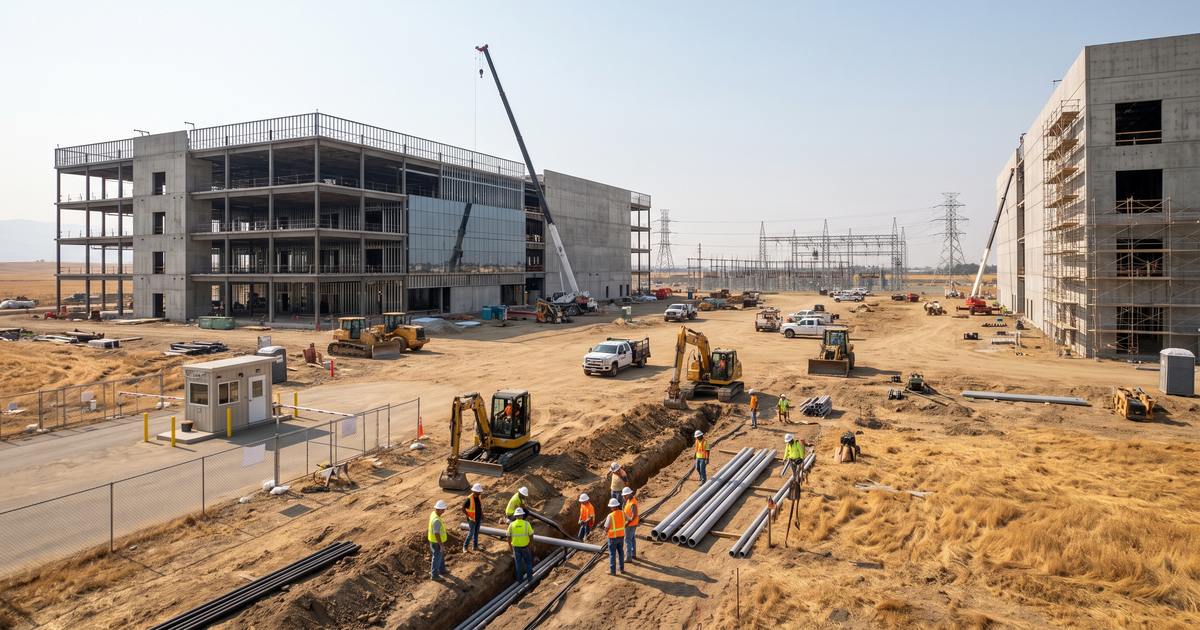
Amazon Web Services is building a two-phase data-center campus at 8050 Camino Arroyo in Gilroy, California. The City of Gilroy lists the project under construction, with grading and underground-utility permits issued December 11, 2025 and a building permit issued March 19, 2026. AWS names Skanska as its construction partner and says the campus broke ground in December 2025. In an April 2026 update, the owner reported that Phase I remained on schedule for a December 2026 operations launch.
The approved program is substantial: two approximately 218,000-square-foot data-center buildings plus a security building, totaling about 438,500 square feet. The architectural and site approval identifies Amazon Data Services as the property owner and applicant, HKS as preparer of the approved project plans, Kimley-Horn as the civil-plan firm, and Pacific Gas and Electric Company as the utility partner. Those names create a clear prime-team map while specialty electrical and low-voltage awards remain unresolved in the public record.
| Project fact | Current detail | Reporting boundary |
|---|---|---|
| Status | Under construction | Phase I targets December 2026 operations. |
| Campus | About 438,500 sq ft | Two data halls plus security building. |
| Grid service | Dedicated 98 MW connection | IT critical load is undisclosed. |
| Building demand | 49 MW maximum each | Electrical demand, not IT load. |
| Builder | Skanska | Named directly by AWS. |
| Construction cost | Undisclosed | Regional investment is separate. |
| Phase II | Timing undisclosed | Backup system remains future scope. |
Capacity needs careful handling. AWS says PG&E will serve the campus through a dedicated 98 MW connection. City approvals set a maximum 49 MW electrical demand for each data-center building. The current city fact sheet also describes a dedicated substation and PG&E-owned switchyard. These numbers define utility service and approved electrical demand. AWS has not published the campus IT critical load, and the standby-generation nameplate from air-permit records belongs in a separate category.
Cost needs the same discipline. The reviewed primary sources do not disclose project construction capex. AWS cites $5.1 billion of Northern California investment since 2010 on its Gilroy project page; that is regional historical context covering a broader portfolio. Assigning that figure to this campus would overstate the public record. The useful pursuit facts are the active construction stage, named general contractor, issued permits, building area, power program, and December 2026 Phase I target.
The Bay Area Air Quality Management District engineering evaluation confirms the two roughly 218,000-square-foot buildings and security building. It also describes 27 Phase I standby engines. Phase II is expected to use battery or fuel-cell backup subject to later permitting if the selected technology creates regulated emissions. Contractors should keep grid capacity, building demand, standby generation, rack-level battery support, and future backup technology as separate design and procurement layers.
| Organization | Source-backed role | Pursuit signal |
|---|---|---|
| Amazon Web Services | Owner / operator | Phase I construction and hiring. |
| Amazon Data Services | Property owner / applicant | Permit and deferred-package records. |
| Skanska | Construction partner | Prequalification and trade packages. |
| HKS | Project-plan preparer | Mission-critical design coordination. |
| Kimley-Horn | Civil-plan firm | Site, utilities, and pathways. |
| PG&E | Utility / switchyard | 98 MW energization and controls. |
| City of Gilroy | Permitting authority | Deferred permits and inspections. |
Skanska's position is the central contractor signal. AWS directly names the company as the construction partner, giving subcontractors a verified route to monitor. Public sources reviewed for this report do not identify the electrical contractor, structured-cabling contractor, fiber/OSP contractor, security integrator, fire-alarm or VESDA contractor, controls integrator, DAS firm, grounding specialist, or commissioning provider. Those packages should remain open watch items until Skanska outreach, permits, company case studies, or award records name them.
Skanska's official subcontractor engagement material describes supplier-diversity teams, trade-partner development, prequalification training, and project-opportunity channels. It does not list a Gilroy-specific open bid package in the reviewed material. Firms should register and build a direct relationship while asking precise questions about the Gilroy project, current package status, insurance and bonding thresholds, safety metrics, data-center references, BuildingConnected invitations, and the correct Bay Area supplier-diversity contact.
The telecom scope starts outside the buildings. AWS describes redundant telecommunications and internet connectivity. A two-building campus with a dedicated security building and future second phase will require coordinated carrier entrances, diverse routes, duct banks, vaults, handholes, backbone fiber, main distribution, building distribution, pathways, labeling, testing, and records. The public sources establish the redundancy requirement and fiber-related workforce signal; they do not disclose topology, carrier names, strand counts, or awarded installers.
Inside the campus, structured cabling and network support connect data halls, offices, operations areas, controls, security, monitoring, and life-safety interfaces. Mission-critical delivery rewards clean pathway coordination, rack and cabinet discipline, bend-radius control, calibrated testing, optical-loss and OTDR records, labeling, as-built documentation, and issue tracking. Teams should expect close coordination with Skanska, HKS, electrical trades, equipment vendors, AWS operations, and commissioning personnel.
Security is visible in the public design. City documents include a dedicated security building, perimeter fencing, and controlled security gates. AWS also lists security specialists among the campus roles. This supports a watch for access control, credentialing, gates, intercoms, CCTV, video management, security networking, visitor processing, monitoring, and acceptance testing. System manufacturers and the security integrator remain undisclosed, so the opportunity should be framed around confirmed functions and future award evidence.
Fire and life safety carry unusually explicit permit signals. The City approval conditions require separate permits for fire alarm, VESDA, underground fire water, fire pumps, sprinklers, and specialty systems. The fact sheet describes advanced fire detection and suppression plus continuous fire-alarm and sprinkler monitoring. That creates coordination across detection, releasing and supervisory interfaces, HVAC shutdown, doors, power, emergency procedures, cause-and-effect documentation, inspections, integrated testing, and final operator training.
Power monitoring and controls extend from the switchyard to the rack. Phase I includes the dedicated substation and PG&E switchyard, UPS systems, short-duration rack-level lithium-ion modules, standby generators, and continuously monitored alarms. Phase II is expected to use battery or fuel-cell backup. The project therefore carries potential scope in protection and controls, SCADA or utility communications, EPMS, BMS, battery monitoring, alarm routing, time synchronization, network segmentation, grounding and bonding, functional testing, and turnover documentation.
| Low-voltage lane | Confirmed project signal | What to qualify |
|---|---|---|
| Fiber / OSP | Redundant telecom and internet | Routes, entrances, splicing, testing. |
| Structured cabling | Two halls plus support buildings | Pathways, racks, labels, QA. |
| Access / CCTV | Security building and gates | Integrator, VMS, door and gate scope. |
| Fire alarm / VESDA | Separate deferred permits | Designer, installer, monitoring, tests. |
| BMS / EPMS | UPS, batteries, backup, alarms | Point lists, networks, sequences. |
| Substation controls | 98 MW dedicated connection | Protection, SCADA, communications. |
| Grounding | Mission-critical electrical campus | Bonding matrix and test records. |
| Commissioning | December 2026 launch target | Scripts, failure tests, closeout. |
The schedule raises the value of commissioning discipline. AWS's December 2026 operations target leaves a finite path for equipment startup, controls integration, alarm validation, fiber and network turnover, security acceptance, life-safety inspections, load testing, failure-mode testing, issue closure, training, and documentation. The published target is an owner update rather than a guaranteed completion date. Permit status, utility energization, equipment delivery, inspection progress, and certificate-of-occupancy records will show whether the launch remains achievable.
The workforce signal is direct. AWS says the development will create hundreds of construction and operations jobs and names network specialists, security specialists, electricians, fiber-optic technicians, engineering-operations technicians, facility managers, and HVAC technicians. It does not provide a Gilroy-only numeric headcount. Teams can monitor Amazon Jobs for current Gilroy openings and use role descriptions to understand owner expectations for safety, troubleshooting, documentation, operational readiness, and mission-critical experience.
For field readiness, fiber teams should bring calibrated power meters, light sources, inspection scopes, cleaning processes, fusion-splicing capability, OTDR experience, and consistent electronic test records. Cabling teams should demonstrate pathway coordination, rack-and-cabinet workmanship, labeling, copper and fiber certification, and high-density data-hall experience. Security and controls firms should show cybersecurity practices, segmented-network experience, point-to-point validation, alarm testing, trend review, and clean commissioning handoff.
Useful preparation paths include BICSI optical-fiber training, BICSI copper training, FOA workforce resources, and OSHA outreach training. These are practical readiness resources. The reviewed project documents do not state that any specific certification is mandatory. Contractors still need to confirm Skanska and AWS project-specific prequalification, safety, insurance, background, equipment, and documentation requirements.
The utility side has a separate supplier route. PG&E publishes supplier-diversity and registration guidance for firms seeking utility work. Registration does not establish a Gilroy award path, yet it gives qualified protection-and-controls, SCADA, communications, grounding, testing, and substation-support vendors a direct place to establish their capabilities. The strongest outreach will reference the 98 MW Gilroy connection and ask which scopes sit with PG&E, its switchyard contractors, Skanska, or Amazon.
Site and water planning also affect systems coordination. AWS says the two buildings will use about four million gallons of water per year for cooling and will transition to reclaimed water when that infrastructure becomes available. The City project page links the approved environmental record and fire-water study, while the fact sheet describes the current utility and backup-power strategy. Controls teams should expect interfaces among cooling equipment, water treatment, leak detection, environmental monitoring, fire-water systems, alarms, trending, and facilities operations. Public sources do not name the controls vendor or publish a final point list.
The Bay Area location adds practical delivery pressure. Trade partners need labor plans that can support a mission-critical schedule, controlled material handling, badging, safety orientation, shift work when required, and rapid response during startup. Long-lead devices, fiber hardware, security equipment, fire-detection components, controls panels, network gear, and test instruments need procurement tracking tied to installation and commissioning dates. A credible pursuit package should show current staffing, nearby service capacity, manufacturer authorizations where relevant, calibrated tools, documented QA procedures, and foremen who can coordinate across electrical, mechanical, IT, security, and life-safety teams.
Near-term watch items are concrete: Skanska prequalification and bid invitations; City deferred permits for fire alarm, VESDA, security, batteries, fire water, pumps, sprinklers, and specialty systems; PG&E substation and switchyard energization; named electrical and low-voltage awards; AWS Gilroy hiring; equipment startup; integrated testing; inspections; and certificate of occupancy. Phase II timing and backup technology should stay unresolved until current records identify a schedule and final design.
Bottom line: the AWS Gilroy campus is active construction with a source-backed general contractor, issued permits, two planned data-center buildings, a dedicated 98 MW grid connection, and a December 2026 Phase I target. The low-voltage opportunity spans redundant fiber, structured cabling, controlled entry, CCTV, fire alarm and VESDA, monitoring, BMS and EPMS, substation communications, grounding, testing, and commissioning. Firms that can document mission-critical quality and enter Skanska or PG&E channels early have the clearest pursuit path while specialty package names are still emerging.
Join 35,000+ Low Voltage Pros
Get weekly permit updates, tool deals, job opportunities, and industry news. No spam, unsubscribe anytime.