
Join Low Voltage Nation — Find project opportunities and showcase your company to thousands of industry professionals
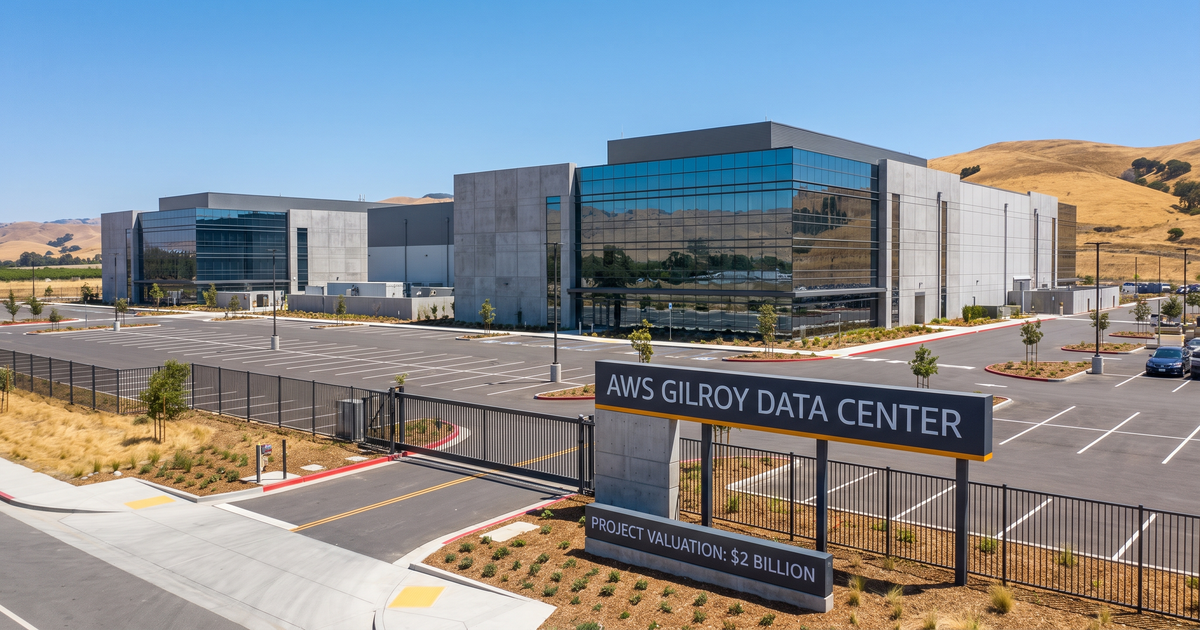
Amazon Web Services built a $2 billion data center in Gilroy, California with no council vote and no public hearing, under 45-year-old industrial zoning. Thirteen low voltage systems - the longest list Signal has produced - including VESDA and EPMS as separate line items, and an estimated $49M to $59M in LV work.
On a 56-acre parcel in east Gilroy, California, Amazon Web Services has built a $2 billion data center. There was no city council vote. There was no public hearing. Half the town found out by accident.
That is not a scandal so much as a zoning fact, and it is the most useful thing in this article for anyone trying to find work before their competitors do. We will come back to it.
First, the building — because this one has the longest low voltage system list LVN Signal has ever produced, and two entries on it have never appeared in a spotlight before.
What Is Being Built
- 8050 Camino Arroyo, Gilroy — 56 acres, roughly 438,500 square feet total
- Two single-story data center buildings of about 218,000 square feet each, plus a 2,500 square foot security building
- A dedicated 98 MW PG&E substation and switchyard, plus offsite transmission and distribution upgrades — each data hall carries a maximum 49 MW electrical demand
- 25 emergency generators at 2.5 MW each
- A potential future Battery Energy Storage System of up to 50 MW in Phase I
- Grading and underground utility permits issued December 11, 2025; building permit March 19, 2026; Amazon has said operations begin by the end of 2026
The named team is unusually complete for a project this early in our coverage: Skanska as construction partner, HKS on the approved project plans, Kimley-Horn on the civil drawings, PG&E owning the substation and switchyard, and Silicon Valley Clean Energy as the carbon-free energy provider.
Thirteen Systems, And Two You Have Not Seen Here Before
Signal scores this campus a 10 out of 10 across thirteen low voltage systems: fiber, outside plant, structured cabling, access control, CCTV, fire alarm, VESDA, BMS and controls, EPMS, networking, security, grounding and bonding, and commissioning.
VESDA and EPMS are broken out as their own line items rather than folded into fire alarm and BMS. On a hyperscale data center that is correct, and it is worth understanding why, because both are places contractors lose money by assumption.
VESDA Is Not Your Fire Alarm Scope
VESDA — very early smoke detection apparatus, more generally aspirating smoke detection — continuously draws air through a network of sampling pipes and analyzes it at a central detector. It identifies smoke at the incipient stage, orders of magnitude earlier than a spot detector.
Data halls need it precisely because of their airflow. High air change rates dilute smoke to the point where conventional spot detection may not alarm until a problem is well developed. Aspirating detection samples continuously from the airstream instead of waiting for smoke to reach a ceiling device.
The practical consequence on this job is stated in the record: the fire alarm and VESDA permits are separate. Separate permit means separate submittal, separate inspection, and very often separate scope. The pipe network is engineered — sampling hole sizing, pipe run lengths, transport time calculations, airflow modeling — and it is designed, not just installed. If you are pricing this as "fire alarm plus some pipe," you have mispriced it.
EPMS Is Not The BMS
EPMS — electrical power monitoring system — instruments the power chain: utility feed, substation, switchgear, UPS, PDUs, breakers, branch circuits. It exists to meter, trend, alarm and report, and it is how the operator knows what is happening electrically in real time and how PUE gets calculated.
The BMS handles mechanical. The EPMS handles electrical. On a data center these are frequently two separate systems, two separate vendors, and two separate contracts, and the interface between them is exactly where scope gaps live. Somebody has to own the integration, the point list reconciliation, and the alarm hierarchy across both.
The record here names specific EPMS-adjacent scope: substation controls, UPS and lithium-ion battery monitoring, continuous alarm and sprinkler monitoring, and integrated testing. Note the lithium-ion piece — a 50 MW BESS brings thermal runaway detection, gas monitoring and NFPA 855 considerations that a flooded-cell battery room never did.
The Number, And A Rare Chance To Check Our Own Work
There is no published construction-only figure, so we price this off capacity — and Gilroy gives us an unusually good opportunity to validate the method, because we have a comparable in the same metro on the same utility.
In July we covered Microsoft's Alviso data center in San Jose: 48 MW of IT load, $28.9 million of estimated low voltage. That is where our $602,000 per MW South Bay anchor came from.
Gilroy Phase 1 is 49 MW. Applying that same-market anchor gives about $29.5 million for Phase 1 — against Alviso's $28.9 million for 48 MW. One megawatt apart, six hundred thousand dollars apart. When an anchor reproduces itself that closely in its home market, you can lean on it.
Across the full 98 MW campus that is roughly $59 million. Our conservative national anchor of $500,000 per MW would give $49 million. Call it $49M to $59M, and lean toward the top of the range here because the comparable is local.
What we do not do is take 4 percent of $2 billion. That would give $80 million. Two billion dollars across 438,500 square feet is roughly $4,560 per square foot, which is not a building cost — it is a building plus Silicon Valley land plus a substation plus a very large amount of computing hardware. The announced figure is bundling, and our capacity math says so.
The Zoning Story Is A Business Development Tool
Now back to the approval, because this is the part worth acting on.
Gilroy's community development director signed off on the project through an administrative Architectural and Site Review Permit under the city's 45-year-old M2 General Industrial zoning, which permits "data processing establishments." No council vote. No public hearing. The backlash has been about oversight, not about the building.
For a contractor, strip out the politics and look at the mechanism: zoning language written decades before hyperscale computing existed permits data centers by right in a lot of American cities. Where that is true, a project can move from site control to grading permit without ever appearing on a council agenda — which is exactly why nobody saw this one coming.
Two things follow. First, a project can be real long before it is publicly visible, so if you wait for the news cycle you are already late. Second, and more useful: go find out where your region's heavy-industrial zoning allows data processing by right. That map is a lead list. It tells you which parcels can absorb a hyperscaler without a fight, and those are the parcels developers are already looking at.
Compare this to the campus we covered in Indianapolis, where organized neighborhood opposition cut a project from three buildings to two. Same asset class, opposite entitlement environment, and the difference showed up directly in scope.
Where The Work Is
Phase 1 is well along — building permit issued in March, operations targeted for the end of the year. If you are not already on it, you are not getting on it.
Phase 2 is the opportunity: a second 218,000 square foot hall and another 49 MW. Plus the potential 50 MW BESS, which is its own monitoring and detection scope and has not been built.
The specialty electrical, fiber, structured cabling, access control, CCTV, fire alarm and VESDA, controls and commissioning contractors are unresolved in public sources. Skanska is the construction partner and the buyout conversation. On a repeat-build owner like AWS with a second phase on the same slab, performing on one package is the qualification for the next one — and AWS builds these continuously.
One more piece of leverage: the campus sits in the South Bay, alongside Microsoft's Alviso project and PG&E's broader capital program. This is not a one-job market. A contractor who builds mission-critical credentials here has somewhere to spend them.
Track projects like this before the bid drops. LVN Signal monitors permits, bids, and construction news across the country and scores every project for low voltage opportunity. See what is in your market.
Join 35,000+ Low Voltage Pros
Get weekly permit updates, tool deals, job opportunities, and industry news. No spam, unsubscribe anytime.