
Join Low Voltage Nation — Find project opportunities and showcase your company to thousands of industry professionals
Applied Digital's $3.6B Delta Forge 1 AI factory is under construction in Rapides Parish with 300 MW critical IT load and unnamed specialty packages.
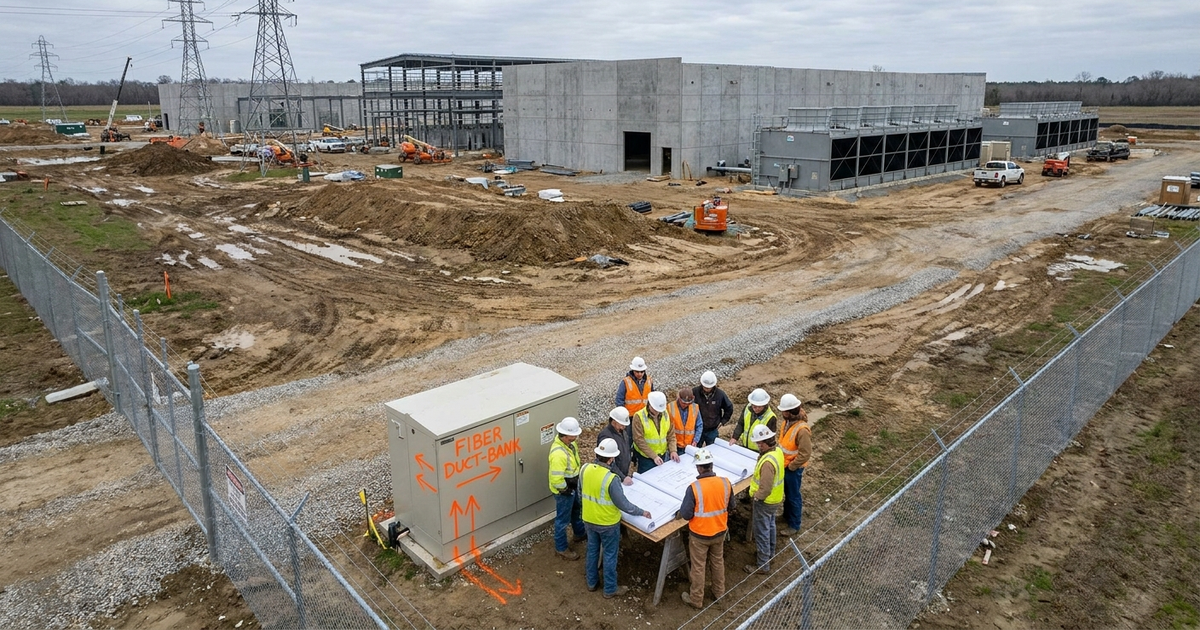
Applied Digital's Delta Forge 1 is now a source-backed AI factory construction signal in central Louisiana. On May 26, 2026, Louisiana Economic Development identified the campus as a $3.6 billion project in Rapides Parish near Boyce. The state announcement says the campus will initially include two facilities totaling 300 MW of critical IT load across roughly 300 acres, with direct access to energy infrastructure, closed-loop cooling, site development already underway, and initial operations expected in mid-2027.
The project also has a separate owner-side source trail. Applied Digital announced the January 22, 2026 groundbreaking before the location was public, describing Delta Forge 1 as a 430 MW total utility-power AI Factory campus in a southern U.S. market. In an April 23, 2026 release filed as an exhibit, Applied Digital said it signed a 15-year lease with an unnamed U.S.-based high-investment-grade hyperscaler covering 300 MW of critical IT load and about $7.5 billion in contracted value. The tenant remains unnamed in the reviewed primary sources, so the safest public framing is clear: this is Applied Digital's campus, with a source-backed hyperscaler lease, but not a named hyperscaler project until a primary source says so.
For LVN, Delta Forge 1 is useful because the big construction facts are public while the specialty contractor layer is still open. The owner/operator, utility, state agency, local economic-development partners, construction start, power requirement, job count, and mid-2027 operations target are all sourced. No reviewed source names the EPC, general contractor, electrical contractor, low-voltage contractor, fiber/OSP contractor, security integrator, fire alarm contractor, BMS/BAS controls integrator, DAS/networking contractor, grounding/bonding team, or commissioning firm. That gap is not a reason to ignore the project. It is the reason to track it early.
Local reporting adds useful corroboration. Baton Rouge Business Report covered the May 26 reveal and repeated the Rapides Parish location, 300 MW critical IT load, Cleco power role, January site-development start, and mid-2027 operations window. Construction trade coverage from Construction Review Online connects the January groundbreaking, April lease announcement, and May location reveal into one timeline. The direct Cleco project release was not suitable for local screenshot capture, but the project-specific power role is sourced through LED, and Cleco Economic Development provides accessible company and service-territory context.
Project Snapshot
| Item | Public Evidence | LVN Takeaway |
|---|---|---|
| Location | Rapides Parish near Boyce, Louisiana. | Central Louisiana site work creates a watchlist around power, access roads, OSP, security, permitting, and commissioning logistics. |
| Construction status | Applied Digital says it broke ground January 22, 2026; LED says site development began in January. | The project is already in the active construction window, not just announcement-stage tracking. |
| Investment | LED reports a $3.6 billion project investment. | The scale supports a serious contractor, workforce, utility, and supplier watchlist. |
| Capacity | Applied Digital describes 430 MW total utility power and up to 300 MW critical IT load; LED describes 300 MW critical IT load across two facilities. | Power delivery, cooling, fiber, controls, security, life safety, and closeout documentation should all be treated as mission-critical scopes. |
| Acreage | LED cites approximately 300 acres; Applied Digital source material describes more than 500 acres. | The acreage difference should stay in the notes until parcel or permit records clarify the exact project boundary. |
| Schedule | Initial operations are expected in mid-2027. | Package awards, job postings, utility filings, and commissioning signals should matter through 2026 and 2027. |
| Jobs | LED expects 200 direct full-time jobs, more than 1,000 peak construction jobs, and 218 indirect jobs. | Contractors and techs should prepare for site safety, documentation, testing, labeling, access control, and data-center QA requirements. |
Named Companies And Public Roles
| Company / Agency | Public Role | Evidence |
|---|---|---|
| Applied Digital Corporation | Owner/operator/developer of Delta Forge 1. | LED announcement and Applied Digital source releases. |
| Cleco | Utility power provider supporting the campus. | LED announcement; Cleco site provides company context. |
| Louisiana Economic Development | State economic-development agency that revealed the Rapides Parish location and public project details. | May 26, 2026 LED announcement. |
| England Economic & Industrial Development District | Local economic-development partner tied to the central Louisiana opportunity. | LED announcement. |
| Louisiana Central | Regional economic-development partner for the Central Region. | LED announcement. |
| Rapides Parish | Local government region for the project. | LED announcement and local coverage. |
The unnamed contractor layer is the current opportunity map. Public sources do not name an EPC, general contractor, electrical contractor, low-voltage contractor, fiber/OSP contractor, structured cabling contractor, security/access-control/CCTV integrator, fire alarm contractor, BMS/BAS controls integrator, DAS/networking contractor, grounding/bonding contractor, or commissioning agent. A contractor should not claim those roles without evidence. A contractor should, however, know which project names and public records to watch: Delta Forge 1, Delta Forge One, DF1, Project Lightning, Applied Digital AI Factory, Boyce data center, Rapides Parish data center, Alexandria-area AI factory, Cleco data center, England Economic & Industrial Development District, and EEIDD.
That kind of open contractor layer is normal at this stage. Owner and state announcements usually lead with capital investment, jobs, schedule, power, and economic-development partners. Specialty contractors tend to surface later through building permits, inspection notes, electrical or fire alarm permit records, public procurement language, utility filings, subcontractor prequalification pages, job postings, supplier references, and project pages added after crews are already on-site. The first useful clue may not say "Delta Forge 1" cleanly. It may use a parcel reference, a Boyce or Rapides Parish location, an EEIDD/England Airpark reference, Project Lightning, a Cleco interconnection phrase, or a generic Applied Digital Louisiana campus label.
That matters because low-voltage work often arrives after the market has already focused on civil, shell, power, and cooling. By the time the public sees security, controls, fiber, fire alarm, or commissioning names, the best-prepared contractors have already mapped the owner, local agencies, utility, permits, safety expectations, and probable schedule pressure. Delta Forge 1 has enough public evidence to start that map now without overstating any unnamed role.
The utility layer also deserves attention. LED says Cleco will provide power to support the large-scale AI and HPC operation. That makes Louisiana Public Service Commission activity, Cleco infrastructure planning, generation or grid-reliability filings, substation signals, interconnection work, and tariff or cost-recovery records relevant to the construction timeline. Power-first data-center projects often reveal low-voltage timing indirectly: security packages around energized yards, communications pathways around utility entrances, controls integration around cooling and electrical systems, and commissioning roles as power and operations milestones converge.
Where Low Voltage Shows Up
| Scope | Why It Matters | Evidence To Watch |
|---|---|---|
| Fiber / OSP | A 300 MW critical-load AI campus needs carrier entrances, diverse routes, duct banks, vaults, clean testing, and documented handoffs. | OSP permits, carrier clues, fiber-route work, utility crossings, vault installation, and contractor pages. |
| Structured cabling | Two initial 150 MW facilities will depend on disciplined pathway, tray, labeling, fiber/copper testing, and closeout practices. | Interior buildout roles, rack/row scope, cabling prequal language, QA documentation, and test-equipment requirements. |
| Security systems | Perimeter, building, loading, equipment, and operations areas need controlled access and camera coverage. | Security integrator awards, access-control jobs, CCTV/VMS roles, fence and gate scope, and badging requirements. |
| Fire alarm / life safety | Large power, cooling, and data hall environments require careful interface work with suppression, monitoring, and AHJs. | Permit revisions, FA contractor activity, special inspections, monitoring requirements, and turnover checklists. |
| BMS / BAS controls | Applied Digital highlights power, cooling, and operational integration; controls will sit close to that story. | Controls integrator roles, sequence documentation, trend logs, commissioning scripts, and alarm integration work. |
| Grounding / bonding | Power infrastructure, telecom spaces, racks, pathways, and equipment rooms all depend on clean bonding discipline. | Electrical coordination notes, grounding tests, bonding inspections, QA records, and commissioning checklists. |
The jobs story should be read as a preparation signal, not a promise that every specialty package is open today. LED says the project should support more than 1,000 construction jobs at peak construction and 200 direct full-time on-site jobs. Louisiana also points companies toward Source Louisiana for vendor registration and opportunity matching. For LVN readers, the practical move is to make sure basic contractor readiness is handled before the package names become public: safety paperwork, insurance, site access, lift planning, data-center references, fiber test documentation, labeling standards, closeout templates, and the ability to coordinate around electrical, mechanical, controls, and commissioning teams.
Jobs, Skills, And Contractor Readiness
| Skill Area | Why It Fits | Useful Resource |
|---|---|---|
| Fiber testing and documentation | AI factory work rewards clean test records, repeatable labeling, and standards-driven closeout. | BICSI fiber training |
| Structured cabling discipline | Pathways, trays, copper, fiber, labels, as-builts, and QA become critical as rooms and rows come online. | BICSI copper training |
| Fiber workforce basics | Growing crews need a shared baseline for handling, cleaning, testing, documentation, and safety. | FOA workforce resources |
| Site safety and access | Large Louisiana data-center construction will require orientations, PPE, lift planning, badging, and disciplined access control. | OSHA outreach training |
The cleanest public posture is conservative. Delta Forge 1 is an active, high-confidence AI/data-center construction project. The owner, utility, state agency, regional partners, investment, jobs, power scale, and schedule are source-backed. The hyperscaler tenant is not named in the reviewed primary sources. The contractor packages are not public yet. That combination is exactly why the project belongs on a low-voltage watchlist now, before the specialty scope becomes obvious.
LVN Signal is tracking Delta Forge 1 as part of the AI/data-center construction intelligence layer so contractors, vendors, recruiters, and techs can follow source-backed company names, public records, job signals, and low-voltage scope movement while the opportunity is still forming.
Join 35,000+ Low Voltage Pros
Get weekly permit updates, tool deals, job opportunities, and industry news. No spam, unsubscribe anytime.