
Join Low Voltage Nation — Find project opportunities and showcase your company to thousands of industry professionals
A Brookwood, Alabama permit identifies an Applied Digital site with a roughly two-million-square-foot building and 136.89 acres of initial disturbance, while the final site decision, power capacity, tenant, delivery team, and specialty contractors remain undisclosed.
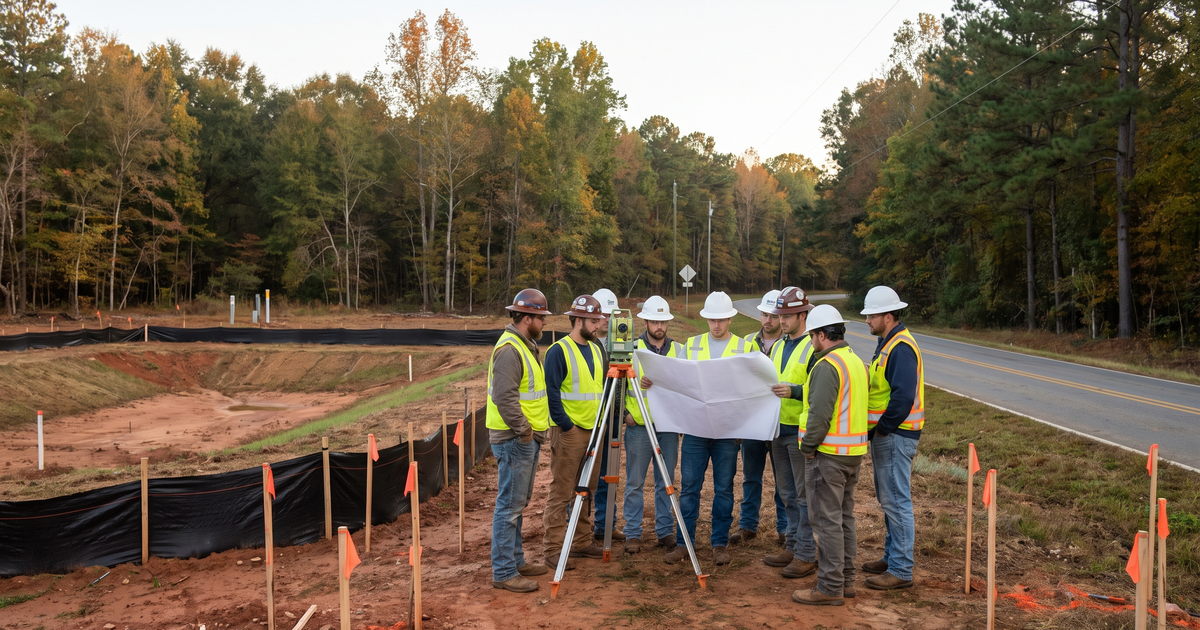
A state construction-stormwater permit has put a large proposed data-center site near Brookwood, Alabama, into a more concrete stage of public review. The Alabama Department of Environmental Management permit package names APLD BHM-01 LLC, describes a building of roughly 2 million square feet, and covers 136.89 acres of initial disturbance inside a 1,292.61-acre property position.
Local property and corporate-record reporting connects the site entity to Applied Digital, a developer of large AI-factory campuses. The filing also names Kimley-Horn as the civil engineer and permit-plan preparer. Those are meaningful construction signals for contractors, manufacturers, integrators, and workforce partners following Alabama's data-center market.
The present status still requires discipline. Applied Digital told Tuscaloosa Thread that it has made no final site decision. The permit authorizes stormwater coverage and supplies anticipated construction dates; it does not establish a notice to proceed for vertical construction. Brookwood-specific power capacity, tenant, capital investment, construction manager, specialty contractors, and equipment awards have not been disclosed.
What the Brookwood permit establishes
| Item | Current evidence | Why it matters |
|---|---|---|
| Site | Brookwood Parkway near 17300 and 17490 Brookwood Parkway | Places the proposal in Tuscaloosa County's industrial corridor |
| Permit | ADEM ALR10C8B4, effective July 20, 2026 | Authorizes construction-stormwater coverage |
| Initial disturbance | 136.89 acres | Defines the first permitted civil footprint |
| Property position | 1,292.61 acres | Shows room for a much larger campus program |
| Reported building | Approximately 2 million square feet | Indicates hyperscale physical scope |
| Permit schedule | July 22, 2026 to December 31, 2028 | Creates a working window for civil monitoring |
The filing supplies front-gate coordinates of 33.210556, -87.270278. Its site description places the work along Brookwood Parkway, adjacent to existing industrial addresses. The acreage figures need to stay separate: 136.89 acres is the area covered by the initial disturbance plan, while 1,292.61 acres is the broader property acreage listed in the permit material.
The 2-million-square-foot description is similarly specific and limited. Current public records do not provide a building count, data-hall count, floor count, phased turnover plan, administrative-building program, or white-space split. A building this large can support major AI infrastructure, yet the permit alone cannot establish critical IT megawatts or final data-center density.
The schedule should be read as a permit-form construction window. Field mobilization, mass grading, building permits, equipment releases, and a developer notice to proceed would each provide stronger evidence that Brookwood has moved from permitted site selection into active construction. Contractors should track those milestones independently.
Construction-stormwater approval still matters because it captures work that must occur before a campus can support buildings and equipment. Clearing limits, erosion controls, grading, drainage, detention, roads, wet utilities, and stabilized access shape where future duct banks, site fiber, power routes, gates, cameras, and temporary networks can go. Civil drawing revisions can therefore become an early source of scope intelligence even while the vertical delivery team remains private.
The broad property position also raises phasing questions. A 1,292.61-acre holding could accommodate multiple buildings, utilities, generation, substations, water infrastructure, laydown areas, and setbacks, but current records do not define that program. Contractors should avoid projecting a campus layout from acreage alone. The useful evidence will come from future plan sets that identify parcels, buildings, utility corridors, access points, easements, and phase boundaries.
The named project team is still small
| Organization | Source-backed role | Current boundary |
|---|---|---|
| APLD BHM-01 LLC | ADEM permittee and site entity | Tenant and delivery structure undisclosed |
| Applied Digital | Parent developer and reported site controller | Final investment decision undisclosed |
| Kimley-Horn | Civil engineer and permit-plan preparer | Broader design or EPCM scope unconfirmed |
| ADEM | State stormwater permitting authority | Permit is not a vertical construction award |
| Tuscaloosa County EDA | Economic-development coordination | Project incentives and procurement undisclosed |
Kimley-Horn's published mission-critical capabilities include campus planning, civil and site design, permitting, roadway, utility, water, power, and fiber coordination. The ADEM package supports its Brookwood civil role. It does not support labeling the firm as the architect, MEP engineer, general contractor, EPCM provider, low-voltage designer, or commissioning authority.
The general contractor or construction manager has not been named. The same is true for the architect, MEP engineer, electrical contractor, utility, carrier, fiber and outside-plant contractor, structured-cabling contractor, security integrator, fire-alarm contractor, controls integrator, DAS provider, grounding contractor, major equipment suppliers, and independent commissioning authority.
That open team structure is the practical business-development story. Early site work often creates the first visible trail through erosion-control plans, grading packages, road improvements, utility easements, temporary power, field-office connectivity, gate and camera installations, and subcontractor prequalification. Later packages become clearer as design drawings, equipment releases, job postings, and trade awards appear.
Procurement may move through several layers. Applied Digital could retain a construction manager or design-builder, and that lead firm could then release major electrical, mechanical, technology, and security packages. Specialty integrators may buy through those primes, directly through the owner, or through equipment manufacturers. A credible pursuit plan needs the actual contract chain, bid-list requirements, insurance limits, bonding terms, safety thresholds, and schedule before a contractor assigns estimating resources.
Keep Brookwood separate from Applied Digital's Delta Forge 2 lease
Applied Digital recently announced a 210 MW critical-IT lease for Delta Forge 2 at a fifth campus in an undisclosed southern state. That announcement includes a first-quarter 2028 initial-operations target and waterless cooling. No owner announcement or project-specific filing reviewed by LVN identifies Brookwood as that campus.
For that reason, LVN is keeping the 210 MW figure, lease revenue, tenant, cooling design, and Delta Forge 2 schedule out of the Brookwood project record. Brookwood's serving utility, requested load, service voltage, interconnection point, transmission route, substation program, backup-generation plan, water source, cooling design, and phased energization schedule remain open.
Brookwood also has reporting around a separate Youngwoo-associated 374-acre data-center proposal. Facts from that project should not be combined with the APLD BHM-01 permit site unless a future primary record establishes a direct relationship.
Where low voltage enters the opportunity
| System | Likely work lane | Evidence to watch |
|---|---|---|
| Fiber and OSP | Duct banks, vaults, entrances, campus backbone, splicing and testing | Carrier routes, utility plans and civil drawings |
| Structured cabling | Pathways, copper and fiber support cabling, labeling and turnover | Design packages and rack-row buildout awards |
| Security | Perimeter detection, gates, access control, CCTV and visitor systems | Site-security packages and integrator hiring |
| Life safety | Fire alarm, monitoring and suppression interfaces | Building permits, AHJ reviews and special inspections |
| Controls | BMS, EPMS, DCIM interfaces and OT networking | MEP drawings, equipment submittals and controls awards |
| DAS and radio | Public-safety and in-building wireless coverage | Coverage studies and carrier coordination |
| Grounding | Telecom bonding, racks, pathways and equipment-room coordination | Electrical specifications and QA requirements |
| Commissioning | Integrated testing, trend logs, documentation and turnover | Cx plans, IST schedules and owner acceptance gates |
These are trade lanes to monitor, not awarded Brookwood scopes. The scale reported in the permit makes them commercially relevant, while the absence of design and procurement evidence limits how specifically any vendor can claim an opportunity today.
Outside-plant work usually becomes visible early because fiber entrances, duct banks, utility crossings, handholes, vaults, and campus routes must coordinate with roads, drainage, power, and grading. A large AI campus also benefits from physically diverse carrier paths and careful loss-budget management. Firms preparing for that work should be ready to document splicing procedures, OTDR and insertion-loss testing, labeling, as-builts, and clean handoff records.
Security, fire alarm, controls, and operational networks have their own coordination burden. Perimeter systems must align with gates, fencing, lighting, civil utilities, and the permanent security model. Fire-alarm interfaces depend on the final building and suppression design. BMS and EPMS integration connects mechanical and electrical equipment to operations, alarm management, trending, and commissioning. Each package can cross several prime and trade boundaries.
Power delivery will be the strongest technical gate. The serving utility has not been identified in the reviewed sources, and there is no Brookwood-specific public load request or substation design. Future transmission routes, line extensions, utility fiber, protection and controls, SCADA, relay testing, grounding grids, metering, and phased energization can create separate contracting lanes. The energization sequence will also influence when controls, security, life safety, networks, and integrated systems testing can begin.
Commissioning should enter planning well before turnover. Mission-critical facilities require documented point-to-point checks, functional testing, alarm verification, trend review, sequence validation, failure-mode testing, and disciplined issue closure. Low-voltage teams need test procedures and closeout records that can survive owner review. Once a commissioning authority and integrated-systems-testing schedule appear, suppliers can work backward to understand submittal, installation, startup, testing, and documentation deadlines.
Jobs, supplier readiness, and the next public checkpoint
Project-specific construction jobs, permanent operations jobs, hiring dates, and craft peaks have not been published. Applied Digital maintains a public careers page, and the Tuscaloosa County Economic Development Authority is a useful local economic-development source. Current WBRC reporting says Brookwood plans a September 1 public-question session about industrial-parkway development, giving residents and contractors another near-term checkpoint.
Trade partners can use the pre-award period to tighten mission-critical qualifications. Useful preparation includes current safety records, insurance, EMR and bonding capacity; manufacturer certifications; structured-cabling and fiber references; test-equipment calibration; grounding and labeling standards; QA/QC plans; commissioning experience; and disciplined closeout documentation.
Technicians moving into data-center work can strengthen fiber installation and testing, cable-tray and pathway coordination, access-control and CCTV commissioning, fire-alarm interfaces, controls networking, grounding and bonding, and turnover documentation. BICSI education and NFPA training provide recognized paths for communications and life-safety development.
The strongest next evidence will come from an Applied Digital final investment decision, a notice to proceed, visible field mobilization, building permits, utility or transmission filings, substation plans, water and cooling disclosures, named design and construction firms, equipment awards, and project-specific hiring. Each one narrows the distance between a permitted site and an active build.
LVN Signal is tracking the Brookwood project at its source-backed stage: planned, permitted for construction stormwater, geocoded, and still awaiting a final site decision. Follow LVN Signal for the next contractor, utility, fiber, security, fire-alarm, controls, workforce, and commissioning developments across North America's AI data-center pipeline.
Join 35,000+ Low Voltage Pros
Get weekly permit updates, tool deals, job opportunities, and industry news. No spam, unsubscribe anytime.