
Join Low Voltage Nation — Find project opportunities and showcase your company to thousands of industry professionals
Amazon Project Eagle in Boling, Texas has four TDLR data-center filings totaling about 756,240 square feet and $1.2B in estimated building value, with Gensler named as design firm and specialty package names still open.
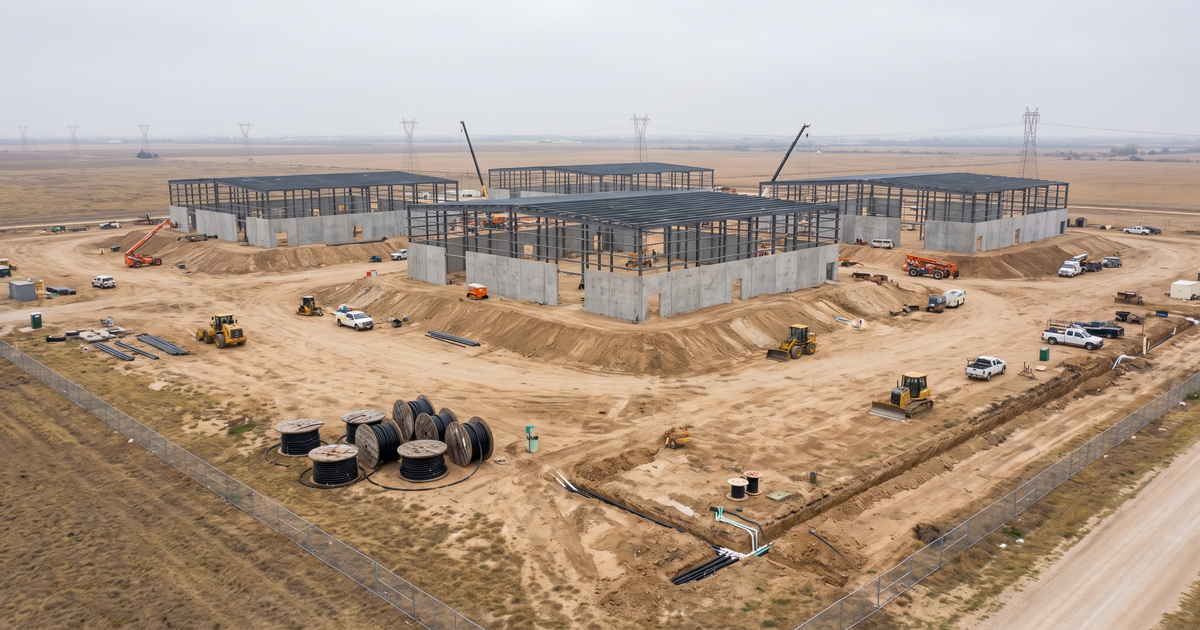
Amazon Project Eagle in Boling, Texas is the kind of early AI data-center signal that matters for low-voltage contractors before the package map is public. The record is not built from a vague market rumor. It starts with four Texas Department of Licensing and Regulation filings for Project Eagle Buildings A, B, C, and D in Wharton County. Each filing lists a new 189,060 square foot data-center building, each carries a $300 million estimated cost, and each names Amazon Data Services, Inc. as the owner. Taken together, the initial public filing package points to roughly 756,240 square feet and about $1.2 billion in filed building value.
The strongest evidence is the TDLR trail. Building A, Building B, Building C, and Building D all sit on Eaglewood Road in Boling. The filings name M. Arthur Gensler & Associates, Inc. as the design firm and show August 1, 2026 as the planned start date. The completion dates split by building: Buildings A, C, and D show January 1, 2027, while Building B shows August 1, 2027. That staggered schedule is a useful watch point because it may produce separate waves of civil, power, data hall, security, controls, and commissioning work.
| Item | Source-backed detail | Why LVN cares |
|---|---|---|
| Owner | Amazon Data Services, Inc. | Hyperscale owner signal tied to AWS data-center delivery. |
| Initial filing scope | Four 189,060 sq ft data-center buildings | Large enough for multiple trade packages and phased turnover. |
| Filed value | $300M per building, about $1.2B total | High-value construction pipeline with low-voltage scope likely downstream. |
| Design firm | M. Arthur Gensler & Associates, Inc. | Named design lead gives contractors a public record anchor. |
| Status | Planned, with TDLR start dates in 2026 | Early enough to watch for GC, MEP, LV, and utility signals. |
Secondary coverage helps explain why the filings are getting attention. The Wharton Post summarized the Boling filing activity and local site context near FM 1301 and FM 442. Data Center Dynamics tied the public filings to AWS and reported the four-building, $1.2 billion campus scope. Baxtel also tracked the filing as an AWS data-center campus outside Houston. Those sources are useful context, but the article stays anchored to the TDLR filings for owner, address, size, cost, design firm, and schedule.
What is not public yet is just as important. Reviewed sources do not name a general contractor, EPCM, electrical contractor, low-voltage contractor, fiber/OSP contractor, structured cabling firm, security integrator, fire alarm contractor, BAS/BMS controls firm, DAS/networking contractor, grounding contractor, utility provider, or commissioning provider. That makes Project Eagle a clean watch-list item instead of a finished contractor map. The correct stance is to publish the known owner/design/public-record facts and keep the specialty package names open until public evidence names them.
| Company or agency | Role | Evidence |
|---|---|---|
| Amazon Data Services, Inc. | Owner/operator | TDLR Building A filing |
| Amazon Web Services | Cloud/data-center context | DCD Project Eagle coverage |
| M. Arthur Gensler & Associates, Inc. | Design firm | TDLR design-firm field |
| Texas Department of Licensing and Regulation | Public filing source | Project D filing |
| Wharton County / Boling area | Local jurisdiction context | Local filing coverage |
| Coastal Bend Groundwater Conservation District | Water permit context | Water permit coverage |
For LVN Signal, the low-voltage opportunity is not a guess that Amazon has already awarded LV packages. It is a systems watch. A four-building hyperscale campus needs fiber entrance pathways, carrier coordination, outside plant routes, MMR and IDF infrastructure, structured cabling, access control, CCTV, fire alarm interfaces, BAS/BMS controls, network coordination, grounding and bonding discipline, testing, labeling, as-builts, and commissioning documentation. Those scopes usually become visible in waves through permits, job postings, plan-room language, vendor announcements, and subcontractor claims.
| System | Why it matters | Watch signal |
|---|---|---|
| Fiber / OSP | Carrier entrances, campus backbone, and diverse routes | Duct-bank permits, carrier work, fiber contractor hiring |
| Structured cabling | Data-hall and support-space pathways, labels, and test records | Fit-out packages, tray work, QA documentation |
| Access control / CCTV | Hyperscale security across perimeter, buildings, and secure zones | Integrator awards, door hardware, VMS, camera packages |
| Fire alarm | Life-safety interfaces with suppression and monitoring systems | AHJ reviews, FA permits, acceptance testing |
| BMS / controls | Monitoring, cooling, alarms, trend logs, and turnover data | Controls integrator jobs and commissioning milestones |
| DAS / networking | Coverage and operational networks in large hardened buildings | DAS design, public-safety coverage, IT/OT handoff language |
The water-permit trail is worth watching because data-center construction does not move only through building filings. A June Wharton Post report said the Coastal Bend Groundwater Conservation District approved smaller construction wells but tabled two larger office-operations well permits after resident concerns. That does not stop the low-voltage story, but it does add timing risk and a public-agency trail. Water, power, generators, substations, stormwater, and utility approvals can all affect when data halls, security systems, controls, and commissioning sequences actually move.
The practical sequencing is likely to matter. A campus can have a public building filing before the market sees the general contractor, electrical prime, security integrator, controls contractor, fiber contractor, or commissioning provider. That early public-record phase is where contractors should build a target list, not a sales fantasy. For Project Eagle, the known facts are enough to justify monitoring: Amazon Data Services is the owner, Gensler is the design firm, the site has multiple data-center buildings, and the local water-permit conversation is already public. The unknown facts are exactly what the next research cycle should try to resolve.
For low-voltage firms, the mistake would be treating the absence of named LV awards as absence of opportunity. Hyperscale projects often hide the relevant work under larger prime packages until late in the public cycle. The useful signals may appear as electrical-subcontractor hiring, security-technician job posts, fiber-splicing openings, BIM/VDC roles, controls startup roles, commissioning roles, or plan-room language that references telecom rooms, MMRs, security rough-in, cable tray, public-safety radio, access-control doors, or owner-furnished network equipment. Those signals are often easier to catch when the project is tracked by alias and public filing number.
There is also a documentation angle. Data centers are not forgiving environments for weak closeout habits. Fiber test results, OTDR traces, copper certification, label schedules, device addressing, panel schedules, pathway photos, fire alarm acceptance records, access-control door schedules, camera views, grounding records, and commissioning punch lists all become part of the owner turnover story. A contractor that wants to be useful on Project Eagle or similar Amazon/AWS work should be preparing its QA and documentation workflow before the package is on the street.
The trade preparation angle is practical. Contractors that want a path into AI data-center work need clean insurance, safety records, references, fiber test gear, calibration discipline, labeling standards, certified techs, lift and site-access readiness, and documentation habits that can survive owner QA. BICSI copper and fiber training, FOA fiber discipline, OSHA site safety, access-control manufacturer training, fire alarm certifications, and BAS/BMS commissioning experience matter because these sites do not reward loose commercial habits.
The regional context also matters. Boling is southwest of Houston, not in the most obvious Dallas-Fort Worth data-center corridor. That gives the project a different vendor and labor question. Contractors should watch Houston, Gulf Coast, and Central Texas firms that already support industrial power, telecom, controls, security, and mission-critical work. The water and utility trail may also pull in firms with industrial-site experience, not only traditional office-campus low-voltage contractors. That is why the follow-up list includes Wharton County, TCEQ, ERCOT, PUCT, water records, utility filings, and local permits rather than only data-center trade publications.
Project Eagle should also stay distinct from other Amazon and AWS data-center records. Amazon Project Green in Montgomery County, Missouri is a separate $10 billion campus announcement. Amazon/AWS activity around Bastrop, DeSoto, Comanche-adjacent power, and other Texas sites should not be collapsed into this Boling row unless public records connect them. The clean Signal approach is one project family, one source-backed location, one deterministic source ID, and a running set of aliases. For this row, the aliases are Amazon Project Eagle, AWS Project Eagle, Boling data center, Wharton County data center, Eaglewood Road data center, and the four TDLR numbers.
For electrical and low-voltage firms around Greater Houston, the near-term move is monitoring, not overclaiming. Watch TDLR/TABS for Project Eagle amendments and additional buildings. Watch Wharton County, Boling-area public records, the Coastal Bend Groundwater Conservation District, TCEQ, ERCOT, PUCT, local utilities, and local permit portals for power, substation, generator, water, and infrastructure filings. Watch job boards and contractor websites for terms like Project Eagle, Eaglewood Road, Boling data center, AWS Boling, Wharton County data center, TABS2026023825, TABS2026023826, TABS2026023832, and TABS2026023834.
The public AWS infrastructure context is also useful. AWS describes its global infrastructure as a network of Regions, Availability Zones, edge locations, and supporting facilities. That does not confirm the exact service architecture for Boling, but it explains why a filed campus like Project Eagle matters beyond one local construction record. When a hyperscale cloud operator expands physical infrastructure, the downstream work touches power, cooling, physical security, networking, and facilities controls. For LVN readers, those are the systems where skilled low-voltage and mission-critical contractors need to be ready before the bid trail is obvious. See AWS infrastructure context here: AWS global infrastructure.
The bottom line: Amazon Project Eagle is a high-confidence planned AI/data-center construction signal because the public filings are specific and repeat across four buildings. It is not yet a confirmed specialty-contractor map. LVN Signal should treat the project as an early watch item with strong owner/design evidence, a clear filed construction footprint, unresolved utility and water context, and open low-voltage package names. That is exactly the point of tracking it now.
Join 35,000+ Low Voltage Pros
Get weekly permit updates, tool deals, job opportunities, and industry news. No spam, unsubscribe anytime.