
Join Low Voltage Nation — Find project opportunities and showcase your company to thousands of industry professionals
Amazon's first three Pecos County data-center filings total 567,180 square feet and $900 million, while Pacifico's private-power build creates a separate multigigawatt construction track.
Amazon Data Services is advancing a three-building AI data-center campus at 6000 TX-18 in Pecos County near Fort Stockton, Texas. Three Texas Department of Licensing and Regulation filings name Amazon as owner and M. Arthur Gensler & Associates as the design firm. Each filing covers a 189,060-square-foot building with a $300 million estimated cost, creating an initial filed set of 567,180 square feet and $900 million.
The data-center buildings sit inside the broader GW Ranch private-power development. Pacifico Energy says its power program is permitted for up to 7.65 GW of gas-turbine nameplate capacity, with 1.8 GW of battery storage and as much as 750 MWac of solar planned. Those figures describe the power campus. Amazon has not disclosed critical IT load, building-level electrical capacity, PUE, or the final data-center phasing plan.
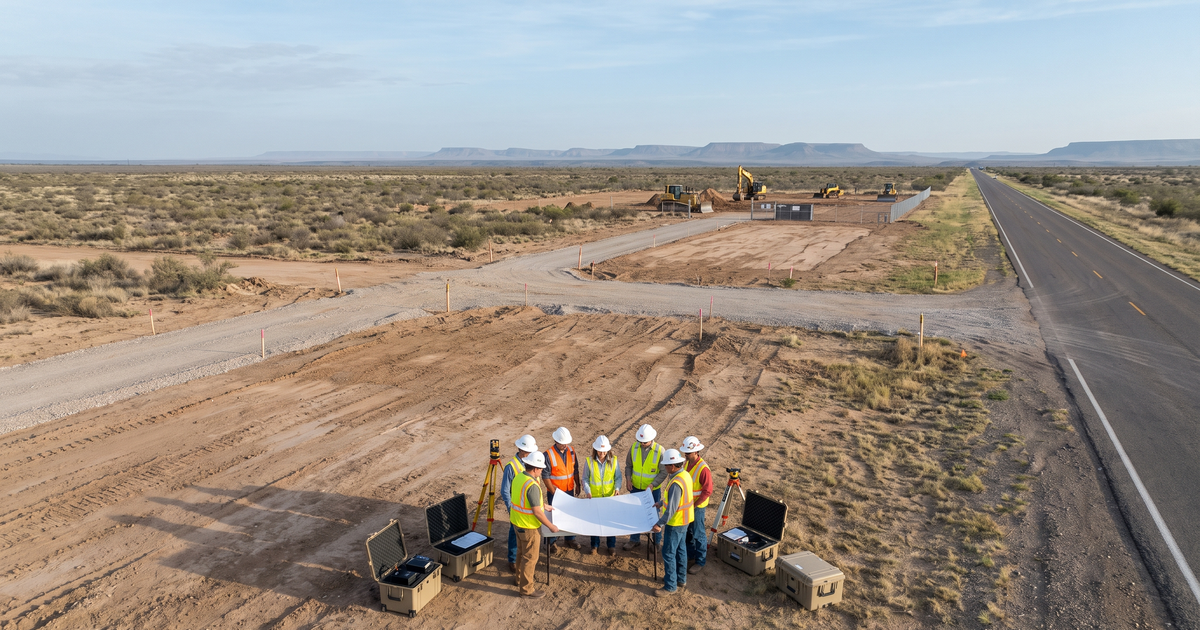
Current evidence supports an under-construction classification at the site-clearing stage. The state registrations carry an August 1, 2026 construction start, and Cleanview reports that July 24 satellite imagery showed land clearing after Amazon directly confirmed acquiring the site. The December 1 completion dates in the building registrations remain filing targets. They do not establish completed shells, commissioned systems, energized data halls, or tenant readiness.
Amazon GW Ranch at a glance
| Item | Current public record |
|---|---|
| Location | 6000 TX-18, Pecos County near Fort Stockton |
| Owner and operator | Amazon Data Services Inc. |
| Initial filed buildings | Three buildings totaling 567,180 square feet |
| Filed building cost | $900M combined TDLR estimate |
| Design firm | M. Arthur Gensler & Associates Inc. |
| Current stage | Land clearing and initial building registrations |
| Power platform | Pacifico GW Ranch private grid |
| Amazon IT load | Undisclosed |
The Texas Comptroller's certified data-center list identifies “Pecos Ranch Data Center,” effective August 10, 2026, with Amazon Data Services as owner, occupant, and operator. The TDLR records use “Pecos County Data Center,” while current construction and energy reporting use Amazon GW Ranch. LVN treats those names as one project family tied to the same owner, address, and power-campus context.
That consolidation matters in the Permian Basin. Chevron and Microsoft’s Project Kilby is a separate Reeves County development. Poolside’s Project Horizon at Longfellow Ranch is also separate. Amazon’s Stingray campus in Andrews County has its own owner and location trail. Contractors tracking West Texas work need the address, filing number, owner, and power developer attached to every lead so distinct campuses do not collapse into one oversized opportunity.
The first three building filings
| Building | Filed scope | Registration |
|---|---|---|
| Building A | 189,060 sf; $300M estimate | TABS2026026954 |
| Building B | 189,060 sf; $300M estimate | TABS2026026955 |
| Building C | 189,060 sf; $300M estimate | TABS2026026959 |
The $900 million total is the sum of three state estimated-cost fields. It is useful as a building-level filing signal. Amazon has not published total campus capital expenditure, financing, committed spend, or spend to date. Pacifico has not published a complete power-campus construction value. The filing estimate should stay separate from future shells, tenant equipment, generation, battery storage, solar, pipelines, substations, transmission, roads, water systems, and land costs.
The same discipline applies to the schedule. All three registrations list August 1 through December 1, 2026. TDLR records are accessibility-project registrations rather than full local building permits or owner progress certificates. The four-month window may reflect the filed scope, a registration placeholder, or an aggressive construction target. Verification will require Pecos County records, Amazon updates, contractor mobilization, foundations, structural activity, equipment deliveries, inspections, or other field evidence.
Named companies and current role boundaries
| Organization | Source-backed role | Current boundary |
|---|---|---|
| Amazon Data Services | Data-center owner, occupant, and operator | IT load, full capex, and package map undisclosed |
| Gensler | Design firm named in all three filings | Detailed consultant and MEP scopes undisclosed |
| Pacifico Energy | Private-power developer and energy-project EPC | Data-center prime role unconfirmed |
| Pacifico GW LLC | GW Ranch Energy Center permittee | Building construction role unconfirmed |
| TDLR | State project-registration authority | Registration is not completion evidence |
| TCEQ | Power-project air-permitting authority | Air permit does not establish IT load |
Gensler is the strongest named data-center design signal. Its critical-facilities practice covers mission-critical work, and the Texas filings tie the firm directly to Buildings A, B, and C. Current public records do not identify the architect-of-record scope split, civil engineer, structural engineer, MEP engineer, technology designer, fire protection engineer, or commissioning authority. Gensler’s filing role should not be expanded into those assignments without source evidence.
Pacifico is the source-backed developer of the co-located energy platform. Engineering News-Record reports that Pacifico expects to self-perform the energy-project EPC function. Reviewed sources do not name Pacifico as the general contractor for Amazon’s data-center buildings. They also do not identify an external data-center GC or construction manager, building electrical contractor, fiber contractor, structured-cabling integrator, security integrator, fire-alarm contractor, controls firm, DAS provider, or independent commissioning agent.
Keep the power figures separate
| Figure | What it describes | Reporting limit |
|---|---|---|
| 7.65 GW | Permitted gas-turbine nameplate | Broader power campus |
| About 5 GW | Nominal delivered generation in permit context | Not Amazon critical IT load |
| 1 GW | Pacifico phase-one generation target | First-power plan for 2027 |
| 1.8 GW | Planned battery storage | Power-platform capacity |
| 750 MWac | Planned solar capacity | Power-platform capacity |
| Undisclosed | Amazon critical IT load | Requires owner or design evidence |
The TCEQ permit letter issued air authorizations to Pacifico GW LLC for the GW Ranch Energy Center. Pacifico’s current plan adds battery and solar resources to the gas-generation platform and targets first phase power in the first half of 2027. The data-center interface will depend on final generator blocks, switchgear, transformers, substations, protection studies, fuel infrastructure, controls, network boundaries, energization sequencing, and commissioning.
For low-voltage and controls firms, the behind-the-meter model creates two connected workstreams. The power campus needs protection communications, SCADA, metering, equipment networks, time synchronization, security, telecom backbones, alarms, historian data, and operational-technology cybersecurity. Amazon’s buildings need the data-hall and facility systems expected in a hyperscale campus. Contract documents will decide where those scopes meet and which contractor owns each interface.
Where low voltage enters the project
| System | Likely project need | Evidence to watch |
|---|---|---|
| Fiber and OSP | Campus entrances, backbone, and power links | Carriers, routes, vaults, splicing, OTDR |
| Structured cabling | Data halls, telecom rooms, and support areas | Pathways, tray, labeling, testing, turnover |
| Access and CCTV | Perimeter, vehicles, buildings, and secure rooms | Integrator, VMS, credentials, acceptance |
| Fire alarm | Life safety across halls and power spaces | Design, interfaces, AHJ review, testing |
| BMS, EPMS, DCIM | Cooling, power, capacity, alarms, and operations | Platforms, points, networks, trend data |
| DAS and radio | Operations and emergency-response coverage | RF study, AHJ criteria, commissioning |
| Grounding and bonding | Telecom, pathways, racks, and equipment | Details, inspection, test records |
| Commissioning | Integrated turnover across multiple phases | Scripts, witness tests, retests, closeout |
Three buildings create a large early pathway and outside-plant problem. Power ducts, campus fiber, carrier routes, security, fire, water, roads, drainage, and future building phases will compete for corridors. Civil, electrical, and communications teams will need coordinated duct banks, handholes, vaults, route diversity, building entrances, separation, grounding, pulling plans, spare capacity, labeling, and accurate as-built records.
The mission-critical interior work will demand repeatable QA. Fiber cleaning, inspection, loss testing, OTDR traces, copper certification, cable-tray coordination, device labeling, rack and pathway documentation, access-control acceptance, camera validation, fire-alarm interfaces, controls point checks, and digital closeout packages all affect turnover. Contractors should expect secure-site rules, material tracking, controlled documentation, strict change management, and witnessed functional testing.
Cooling also affects low-voltage scope. Amazon and Pacifico have described water-efficient or closed-loop approaches using non-potable or brackish sources, while detailed building cooling design remains undisclosed. Final mechanical selections will define leak detection, BMS points, alarms, valve and pump controls, network segmentation, emergency sequences, and commissioning coverage. Water permits, well records, discharge terms, and equipment schedules can reveal the next design layer.
Jobs, procurement, and contractor readiness
Pacifico’s GW Ranch project page projects more than 1,000 construction jobs across the broader development and publishes GWRanch@pacificoenergy.com for vendor and contractor interest. The contact is a real project resource for the power campus. It is not presented as an Amazon bid list, a released low-voltage package, or proof that a contractor has been shortlisted.
Firms approaching the opportunity should be precise about the lane they serve. Power-generation suppliers may fit Pacifico’s vendor intake. Data-center integrators will need the eventual Amazon delivery team, GC or construction manager, electrical prime, design consultants, or procurement portal. A short capability sheet should show mission-critical experience, West Texas staffing, safety results, insurance and bonding capacity, test equipment, manufacturer certifications, BIM coordination, QA procedures, secure-site discipline, digital closeout examples, and commissioning support.
Technicians can prepare through BICSI education and certification for ICT design, installation, pathways, and project management; Fiber Optic Association resources for OSP construction, splicing, cleaning, loss testing, and OTDR documentation; and OSHA outreach training for site-safety readiness. Data-center work also rewards grounding and bonding knowledge, labeling discipline, redline accuracy, lift readiness, lockout awareness, controlled material handling, and the ability to document every test.
What would confirm the next construction stage
The highest-value next records are local building and civil permits, a notice to proceed, named general contractor or construction manager, mobilization evidence, foundation activity, structural awards, and Amazon project hiring. Design updates could identify civil, structural, MEP, technology, fire protection, and commissioning firms. Procurement updates could expose electrical, switchgear, fiber, OSP, security, fire alarm, BAS/BMS, EPMS/DCIM, DAS, networking, grounding, and commissioning packages.
The power side has its own checkpoints: turbine and generator OEMs, battery and solar vendors, gas-pipeline contractor, substation EPC, transformer and switchgear suppliers, protection-and-controls integrator, SCADA platform, fiber backbone, and independent commissioning authority. First power in 2027 will require a visible chain from permits and equipment orders through installation, backfeed, functional tests, and energization.
LVN Signal will track Amazon GW Ranch across new building registrations, Pecos County records, TCEQ amendments, power packages, owner updates, named contractors, carrier routes, hiring, and field progress. The opportunity is already concrete enough for contractors to organize qualifications and source monitoring. Actionable bid access begins when a verified buyer, package, prequalification path, or delivery partner becomes public.
Join 35,000+ Low Voltage Pros
Get weekly permit updates, tool deals, job opportunities, and industry news. No spam, unsubscribe anytime.