
Join Low Voltage Nation — Find project opportunities and showcase your company to thousands of industry professionals
Amazon Data Services filed a $300M, 189,060-square-foot Floydada data-center building with Gensler on design and an April 2027 target.
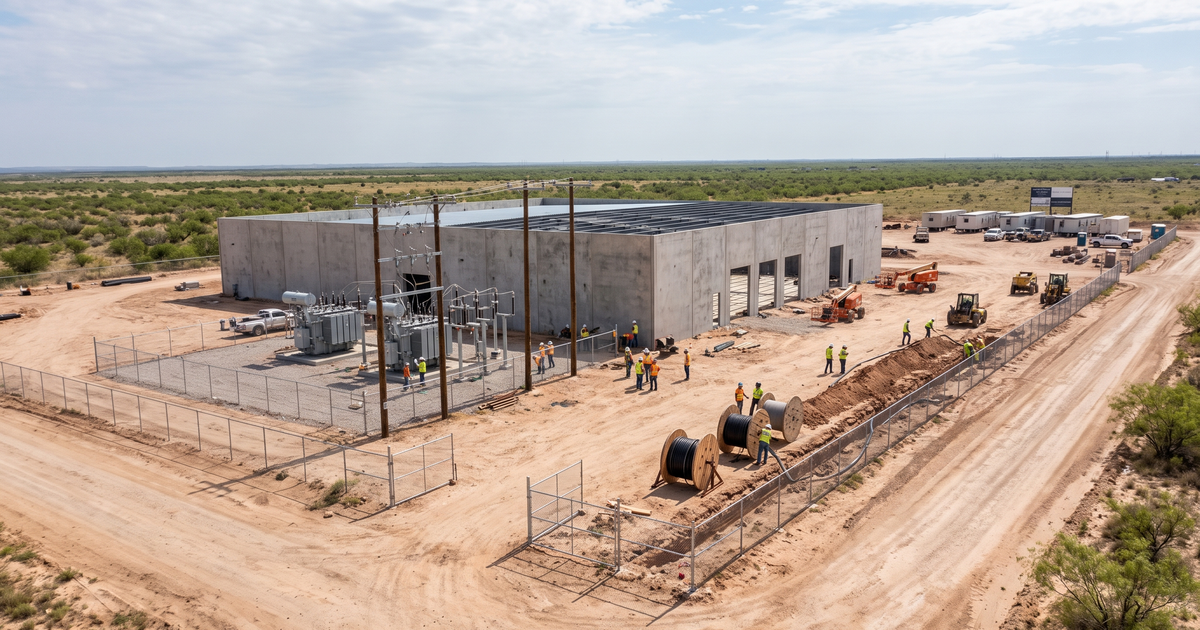
Amazon Data Services now has a public building record in Floydada, Texas. Texas Department of Licensing and Regulation filing TABS2026025594 identifies a new 189,060-square-foot data-center Building A at 1752 County Road 241. The filing lists Amazon Data Services as owner, M. Arthur Gensler & Associates as design firm, a $300 million estimated cost, an August 1, 2026 construction start, and an April 1, 2027 completion target.
The state filing is reinforced by local mobilization evidence. Floyd County Record reports that county commissioners approved a road-use, repair, and improvement agreement with Amazon Data Services. That agreement does not name trade contractors, but it is a practical signal that heavy construction traffic, site logistics, roadway protection, and public-infrastructure coordination have moved beyond a speculative land discussion.
The capacity picture is less certain. An older Floydada site-marketing document described 250 MW of near-term power, a multi-gigawatt expansion path, 345 kV transmission, planned substation infrastructure, and Zayo and AT&T fiber. The document now returns a 404 and predates the Amazon filing. LVN is treating those numbers as secondary site-family context only, not as confirmed Building A capacity. Building-level MW and critical IT load remain unknown.
| Project fact | Source-backed detail | LVN read |
|---|---|---|
| Owner | Amazon Data Services | Named by TDLR. |
| Filed scope | 189,060 sq ft Building A | New data-center construction. |
| Estimated cost | $300 million | TDLR estimate, not total campus capex. |
| Schedule | Aug. 2026-Apr. 2027 | Public filing target. |
| Address | 1752 County Road 241 | Floydada, Floyd County. |
| IT capacity | Not disclosed | Do not assign the older 250 MW figure. |
Amazon Data Services is the named owner in the filing. AWS describes its global infrastructure as the physical foundation for cloud regions, availability zones, and edge services, but its public infrastructure page does not yet identify Floydada as a named AWS region or disclose the tenant, workload, or Building A power profile. The project should therefore be described as an Amazon Data Services data center, not as a confirmed named region or customer deployment.
TDLR identifies M. Arthur Gensler & Associates as the design firm. Gensler's critical-facilities practice documents the firm's data-center and mission-critical capabilities. That supports the design role recorded by the state. It does not identify the general contractor, EPCM, engineer of record, electrical contractor, controls integrator, security integrator, fire-alarm contractor, fiber contractor, network integrator, or commissioning authority for Floydada.
The local public-record path matters because county actions often surface before trade awards. The Floyd County government site, commissioners-court records, road agreements, development approvals, emergency-services coordination, and future permit or inspection records are likely places to watch for contractor names, access requirements, construction traffic, utility work, and site milestones.
| Company / agency | Source-backed role | Current limit |
|---|---|---|
| Amazon Data Services | Owner | TDLR filing |
| Gensler | Design firm | Critical-facilities context |
| Floyd County | Road and local jurisdiction | Road agreement |
| GC / EPCM | Not publicly named | Do not infer an award. |
| Electrical contractor | Not publicly named | Monitor permits and hiring. |
| Specialty trades | Not publicly named | Packages remain open signals. |
For low-voltage contractors, the filed building size and compressed schedule are the useful facts. A 189,060-square-foot mission-critical building moving from an August 2026 start to an April 2027 target creates a short coordination window. Pathways, grounding, utility interfaces, fiber routes, security zones, controls networks, fire-alarm sequences, device rough-in, equipment-room readiness, testing, and turnover all have to be coordinated before the final months become a commissioning pileup.
Outside plant should be treated as an enabling package, not a late communications add-on. The site will need utility and carrier coordination, entrance pathways, protected duct banks, handholes or maintenance holes, building entrances, splice strategy, route diversity, labeling, grounding, optical-loss testing, OTDR traces, connector inspection, as-builts, and restoration plans. The older marketing document names Zayo and AT&T as site-family fiber context, but neither carrier is confirmed for the filed Amazon building.
Contractors can use Zayo's data-center connectivity resources and AT&T's business-fiber resources to understand the carrier capabilities that may be relevant in West Texas. Those links are company capability references only. A Floydada route, service order, meet-me-room assignment, or carrier award requires project-specific evidence.
Power infrastructure deserves the same discipline. The site-family marketing material referenced Southwestern Public Service territory and high-voltage infrastructure. Xcel Energy's Texas service information is useful utility context, but reviewed public records do not yet confirm the serving utility, substation scope, energization date, or Building A load. LVN will keep MW, utility, generation, and interconnection fields unresolved until Amazon, Xcel/SPS, ERCOT, the PUCT, or a public permit names them.
| Low-voltage lane | Likely requirement | Watch signal |
|---|---|---|
| Fiber / OSP | Carrier, utility, and campus links | Duct banks, entrances, splice and test work. |
| Structured cabling | Operations, support, and controls | Pathways, labeling, certification, closeout. |
| Security | Perimeter, gates, rooms, assets | Access control, CCTV, intercom, SOC links. |
| Fire alarm | Data halls and electrical spaces | Detection, interfaces, sequence testing. |
| BMS / EPMS | Power, cooling, alarms, trends | Point lists, networks, dashboards. |
| Commissioning | Phased integrated turnover | Scripts, witnesses, IST, training. |
Inside Building A, structured cabling will support operations, offices, support rooms, monitoring, controls, wireless, security, and customer or owner networks. The final compute topology is not public, but the facility will still require coordinated cable tray and pathways, equipment-room layouts, racks and cabinets, copper and fiber patching, labeling, testing, port records, redlines, digital as-builts, and a turnover package that operations teams can maintain.
Physical security will likely span the site perimeter, construction entrance, vehicle gates, loading and receiving, utility yard, equipment rooms, meet-me rooms, operations spaces, data halls, and customer assets. Watch for badging, visitor management, access control, CCTV, video analytics, intercom, duress, key control, perimeter detection, alarm monitoring, and integration between construction-phase and permanent systems. No integrator has been publicly named.
Fire and life safety will cross data halls, electrical rooms, generator and battery areas, cooling infrastructure, offices, and exterior support equipment. Potential scope includes early-warning detection, fire alarm, suppression interfaces, supervisory points, emergency-power sequences, releasing panels, monitoring, cause-and-effect matrices, acceptance testing, and integrated testing with security, controls, and power systems. The local authority, engineer, vendor, and installing contractor remain unknown.
BMS, EPMS, SCADA, and controls networking will be central to the operating model. Teams should watch for visibility into switchgear, UPS systems, generators, meters, cooling equipment, pumps, leak detection, environmental sensors, alarms, trends, and failure sequences. The boundary between electrical controls, mechanical controls, utility telemetry, security, customer monitoring, and facility DCIM can create major coordination risk if it is not resolved early.
Grounding and bonding will touch utility service, switchgear, generators, UPS equipment, cooling systems, structural steel, lightning protection, telecom entrances, communications rooms, cable tray, racks, controls panels, security devices, and OSP pathways. Low-voltage bidders should ask who owns testing, documentation, coordination, and corrective work across electrical and communications scopes instead of assuming those responsibilities will be cleanly divided.
Commissioning is the final bridge between construction progress and usable capacity. The project will need factory and site acceptance, point-to-point verification, fiber readiness, network validation, cooling sequences, alarm testing, security and fire interfaces, failure-mode testing, integrated systems tests, customer witness points, operator training, punch-list control, and clean digital closeout. A short public schedule makes progressive turnover and room-by-room readiness especially important.
Contractor readiness should include Texas licensing, mission-critical references, safety and EMR records, bonding and insurance capacity, regional labor plans, lift and site-access training, fiber cleaning and inspection, fusion splicing, OTDR and optical-loss testing, copper certification, pathway coordination, grounding, access-control and VMS commissioning, fire-alarm acceptance support, controls point-to-point testing, redlines, labeling, and electronic as-builts.
Prequalification packages should show QA/QC procedures, test-equipment inventories, manufacturer certifications, field supervision, schedule controls, equipment tracking, change management, commissioning experience, and examples of complete turnover records. For a rural West Texas project, bidders should also show mobilization, lodging, material storage, delivery sequencing, temporary connectivity, weather planning, and the ability to maintain staffing through energization and integrated testing.
The road agreement adds a practical logistics layer. Heavy civil work, electrical equipment deliveries, generators, switchgear, cooling equipment, prefabricated assemblies, cable reels, security infrastructure, and workforce traffic all depend on reliable access. County road restrictions, repair obligations, traffic control, delivery windows, staging areas, and emergency access can affect when low-voltage material and crews can enter the site.
A Floydada critical-infrastructure field-engineering job signal associates Amazon Data Services with the market. It is useful as a monitor-only hiring indicator, not proof of a specific contractor award. Future Amazon, Gensler, contractor, utility, and supplier job postings may reveal controls, network, security, electrical, commissioning, and operations responsibilities before formal project announcements do.
The most important watch items are the named general contractor or EPCM, engineer of record, electrical contractor, serving utility, substation and interconnection records, building permits and inspections, generator or air permits, fiber-route evidence, carrier entrances, security and fire-alarm awards, BMS and EPMS vendors, and the commissioning authority. Each source should be tied to Building A or the Floydada address before it is promoted from market context to a confirmed project role.
Track Amazon Floydada, Amazon Data Services Floydada, Confidential Data Center Building A, TABS2026025594, 1752 County Road 241, Floyd County data center, Floydada hyperscale campus, and Floydada Amazon road agreement. Keep this project distinct from Amazon Project Eagle in Wharton County, Amazon Project Green in Missouri, and other Amazon or AWS Texas campuses.
The business-development angle is direct. LVN now has a source-backed owner, design firm, address, filed cost, building area, schedule, and county road agreement. Amazon Data Services, Gensler, Floyd County, and future trade partners can correct the record, claim company profiles, provide verified package or hiring updates, or sponsor continued coverage. Contractors can use the record to focus outreach without pretending the unknown packages are already awarded.
Bottom line: Floydada has moved from powered-land marketing into a named Amazon building record. TDLR supports a $300 million, 189,060-square-foot Building A with Gensler on design and an April 2027 target, while Floyd County has approved a road agreement with Amazon Data Services. Building-level MW, the serving utility, GC/EPCM, electrical, fiber, security, fire alarm, controls, networking, grounding, and commissioning firms remain unknown. Those unresolved packages are the next signals that matter to LVN contractors.
Join 35,000+ Low Voltage Pros
Get weekly permit updates, tool deals, job opportunities, and industry news. No spam, unsubscribe anytime.