
Join Low Voltage Nation — Find project opportunities and showcase your company to thousands of industry professionals
Accokeek Center's two-building, 590,000-square-foot Stafford County plan advanced after a 4-3 Planning Commission recommendation, opening the next watch window for power, design and specialty trade packages.
Stafford County's next large data-center proposal has cleared a meaningful planning milestone. On August 26, the Stafford County Planning Commission voted 4-3 to recommend approval of Accokeek Center's rezoning, substation-compliance review and conditional-use permit. The applications now move to the Board of Supervisors, which retains final approval authority.
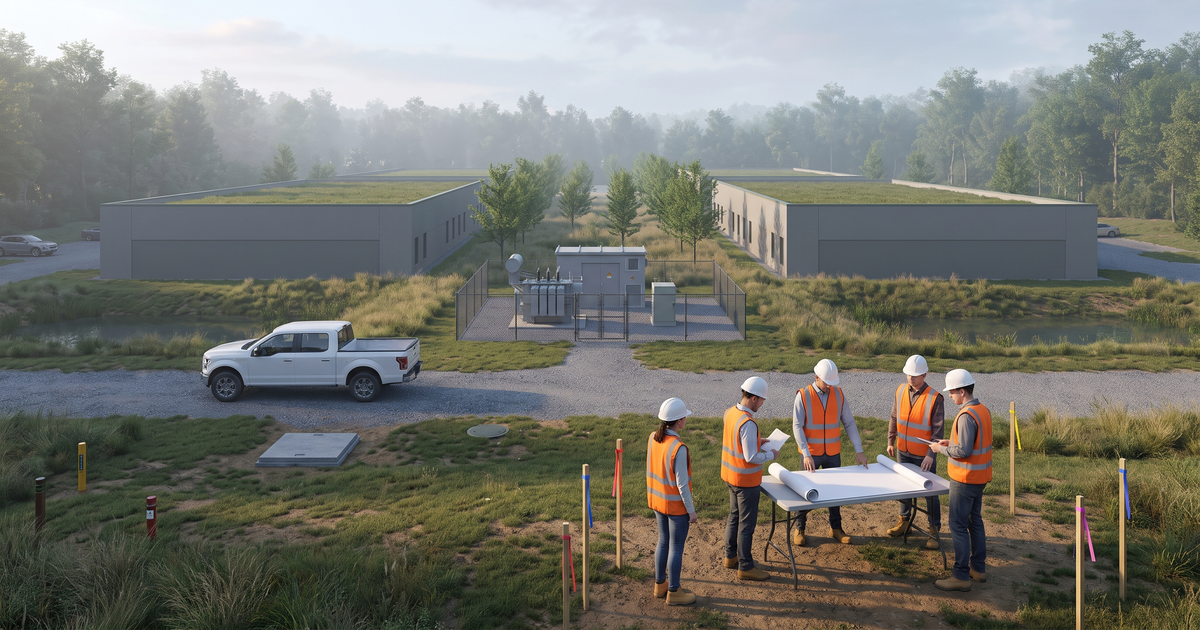
The current plan from Falmouth Tech LLC covers two two-story data-center buildings totaling up to 590,000 square feet on 120.88 acres between Interstate 95 and Richmond Highway in Virginia's Falmouth District. The county packet identifies 122 megawatts as the applicant's necessary power demand and shows a centrally located substation pad. Falmouth Tech describes an expected $2.4 billion investment, approximately 200 skilled-trade construction jobs over 24 to 36 months and more than 64 permanent jobs.
Those figures describe a planned campus. Public records reviewed by LVN do not yet show Board approval, a site or building permit, an executed utility-service timeline, a named operator or tenant, a general contractor, or awarded low-voltage packages. That gap is the opportunity window: the project is specific enough to follow, while many delivery roles remain unresolved.
Accokeek Center project snapshot
| Project fact | Current public figure | How to read it |
|---|---|---|
| Current plan | Two buildings; up to 590,000 sq. ft. | July/August 2026 version |
| Site | 120.88 acres in Stafford County | Eight-parcel application area |
| Power request | 122 MW necessary demand | Applicant figure; IT load undisclosed |
| Investment | $2.4B expected | Developer planning estimate |
| Construction work | About 200 skilled-trade jobs | Developer forecast over 24-36 months |
| Stage | Planning Commission recommended approval | Board action remains pending |
The best primary overview is the Accokeek Center project FAQ. The detailed application trail sits in Stafford County's August 26 Planning Commission packet, while the county's meeting record anchors the public hearing. The developer's July 14 illustrative development plan shows the current building footprints, equipment areas, water-tank area, access and centrally placed substation.
What the Planning Commission vote changed
The 4-3 recommendations moved three related applications forward: rezoning under RC24155981, comprehensive-plan compliance review for the substation under COM24156541, and the substation conditional-use permit under CUP25156540. Potomac Local's hearing report records separate favorable recommendations after a session that ran past midnight. The Fredericksburg Free Press also documented the vote, the redesign and community objections.
The revised version is materially different from the proposal reviewed earlier in 2026. It drops one building, reduces total proposed building area by about 100,000 square feet, moves the substation toward the center of the property and increases separation and tree preservation. The current two-building layout supersedes older public summaries that described three buildings and either 520,000 or roughly 690,000 square feet. Stafford's application review page remains useful for application lineage, although its high-level scope fields trail the current packet.
The vote is a planning recommendation. The Board of Supervisors still must act on the rezoning and substation requests. After land-use approval, the project would still face detailed site-plan review, land-disturbance and grading approvals, building permits, generator and environmental requirements, utility sequencing and construction procurement.
Power: 122 MW is a demand request
The county staff report says the applicant identified 122 MW of necessary power demand through an engineering-study authorization. That number should stay in its proper lane. It is the stated campus power requirement, rather than a disclosed critical IT load, an executed service agreement, presently available capacity or energized demand.
Dominion Energy Virginia is the prospective serving utility. The staff record says the transmission alignment, State Corporation Commission process, certificate path and delivery timing remain unresolved. Public sources also leave the substation designer, protection-and-control team, construction contractor, communications architecture and upgrade-funding boundaries unnamed.
For contractors, power uncertainty matters because it governs the real schedule. A rezoning approval can open more design and procurement activity, while utility milestones determine when the campus can energize data halls. Watch for a service agreement, high-load review outcome, transmission filing, substation design package, right-of-way activity, long-lead electrical orders and a credible energization sequence.
The named project team
The planning record identifies several firms with specific preconstruction roles. LVN keeps those roles narrow. A consultant named in a land-use packet has not automatically won a later building-design or construction package.
| Organization | Sourced role | Evidence |
|---|---|---|
| Falmouth Tech LLC | Applicant and developer | Project site |
| Urban Ltd. | Development plan; land-planning/civil work | Firm site |
| Gorove Slade | Traffic impact analysis | Firm site |
| Mangum Economics | Fiscal impact analysis | Firm site |
| Ramboll | Acoustic/environmental studies | Data-center practice |
| Hirschler | Applicant land-use and zoning counsel | Practice page |
| Dominion Energy Virginia | Prospective electric utility | Utility site |
No reviewed primary source names the campus operator or tenant. An AWS traffic-study reference in the application is a trip-calculation method; it does not establish Amazon ownership or tenancy. The public record also leaves the general contractor or construction manager, building architect, structural and MEP engineers, electrical contractor, mechanical contractor and commissioning authority open.
Where low voltage shows up
A two-building mission-critical campus with an enclosed substation, secure equipment yards, backup generation and round-the-clock operations creates a wide technology scope. The table below describes likely system lanes based on the facility type and site plan. It does not assign packages to firms that have not been publicly selected.
| System lane | Why it belongs | Opportunity signal |
|---|---|---|
| OSP and campus fiber | Two buildings, utility areas and carrier entrances | Duct bank, vault, route or carrier filings |
| Structured cabling | Data halls, operations and support spaces | Fit-out, pathway and rack/row packages |
| Access control and CCTV | Perimeter, gates, yards and secure interiors | Security consultant or integrator award |
| Fire alarm interfaces | Large mission-critical buildings and generators | AHJ submittals and life-safety packages |
| BAS/BMS and monitoring | Cooling, alarms and equipment coordination | Controls sequences and integrator selection |
| EPMS/DCIM | 122 MW power request and phased operations | Power-monitoring and software scope |
| Substation communications | Protection, SCADA and utility coordination | CPCN, relay and controls package |
| DAS and public safety radio | Large hardened buildings | Coverage study and AHJ requirements |
| Commissioning | Integrated mission-critical turnover | CxA, IST and acceptance milestones |
Cooling creates another controls-heavy lane. The proffers prohibit groundwater and public or private potable water for industrial cooling. Reuse water is proposed when capacity and an agreement are available, with air-based or another non-potable solution as the alternative. The final mechanical basis, water-service agreement, extension scope, metering, leak detection and controls packages remain public watch points.
Site constraints will shape the package plan
The hearing record shows a project working inside real community and environmental constraints. County staff cited proximity to an existing transmission corridor, placement inside the Urban Services Area and Central Stafford Targeted Development Area, generator yards oriented generally away from homes, a 443-trip daily cap, a shared-use path, Route 1 turn lanes and at least 40 percent open space. The developer also commits to Tier 4 or better backup generators and continued noise compliance.
Opponents focused on requested setback reductions, the unresolved transmission route, tree-save areas, mixed-use future-land-use designation and uncertainty around cooling infrastructure. Those issues can affect constructability and trade sequencing. A final transmission corridor may add clearing, crossings, protection systems and utility communications work. Expanded buffers can move roads, duct banks, fence lines and camera coverage. A different cooling basis can change controls, monitoring and commissioning needs. Contractors should treat the current illustrative plan as a planning framework until approved civil, utility and building documents establish package boundaries.
The project's $6.4 million in proposed direct county contributions and projected tax revenue are part of the land-use case. They do not fund or identify particular technology packages. For opportunity tracking, permits, procurement notices and named delivery firms remain stronger evidence than fiscal projections.
Jobs, trades and qualification routes
Falmouth Tech forecasts roughly 200 skilled-trade construction jobs across a 24-to-36-month build and more than 64 permanent technical and operations positions. The fiscal study models the first building becoming operational in 2029. These are forward-looking estimates tied to approvals, power, financing and construction. They are not an active headcount report or a list of open requisitions.
For low-voltage firms and technicians, the useful preparation list is familiar: mission-critical safety, fiber installation and test documentation, copper and fiber labeling, grounding and bonding, secure-site badging, lift access, pathway coordination, redlines, as-builts, quality-control records and integrated systems testing. The BICSI Installer 2 Optical Fiber and Installer 2 Copper paths can strengthen field credentials. The Fiber Optic Association workforce resources and OSHA Outreach Training Program add practical training routes.
Companies seeking real project access should watch for the GC/CM announcement and subcontractor prequalification portal. That is usually where insurance, bonding, safety metrics, data-center experience, manpower, quality plans and geographic coverage become actionable. For technicians, project-specific hiring should follow actual package holders rather than the headline job estimate.
What can unlock executable work
The next decisive public milestone is the Stafford County Board of Supervisors hearing and vote. Approval would move the campus deeper into design, utility and permitting work. A denial or deferral would reset the schedule. Either way, the Board package should clarify outstanding land-use conditions and may add new proffers or infrastructure detail.
After that, the strongest contracting signals are a Dominion service commitment and transmission route; detailed civil and building permits; a GC, CM or EPC/EPCM appointment; long-lead generator, switchgear, UPS and cooling orders; and named fiber, security, controls, fire-protection and commissioning partners. Site clearing by itself would reveal less than an issued construction package tied to an accountable firm.
Accokeek Center is a high-confidence project to track because its site, current scale, applications, applicant, planning consultants, power request and public decision path are documented. The procurement map remains incomplete. That combination gives contractors time to prepare without overstating work that has not been awarded.
Follow Accokeek Center in LVN Signal for project-stage changes, company links, jobs, low-voltage scope and the public milestones that can turn this Stafford County proposal into bid-ready work.
Join 35,000+ Low Voltage Pros
Get weekly permit updates, tool deals, job opportunities, and industry news. No spam, unsubscribe anytime.